Period: Monday 4 May 2026 – Sunday 10 May 2026
Classification: UNCLASSIFIED // OSINT
Prepared for: International Guild of Master Bomb Technicians
Prepared: 11 May 2026
NOTE: This reporting week coincides with three active conventional conflict theaters generating high-volume kinetic activity: (1) the 2026 Iran war (US/Israel vs. Iran, including Hormuz naval engagements 4–10 May), (2) the 2026 Lebanon war (Israeli strikes on Hezbollah Radwan Force in Beirut suburbs 6 May), and (3) the JNIM/FLA spring offensive in Mali. Conventional munitions employment (airstrikes, naval missiles, MLRS) is excluded from incident carding. Only IED, improvised explosive, criminal explosive, and ERW incidents are carded below. Conventional conflict context with IED/asymmetric implications appears in the Appendix.
Audio Summary
EXECUTIVE SNAPSHOT
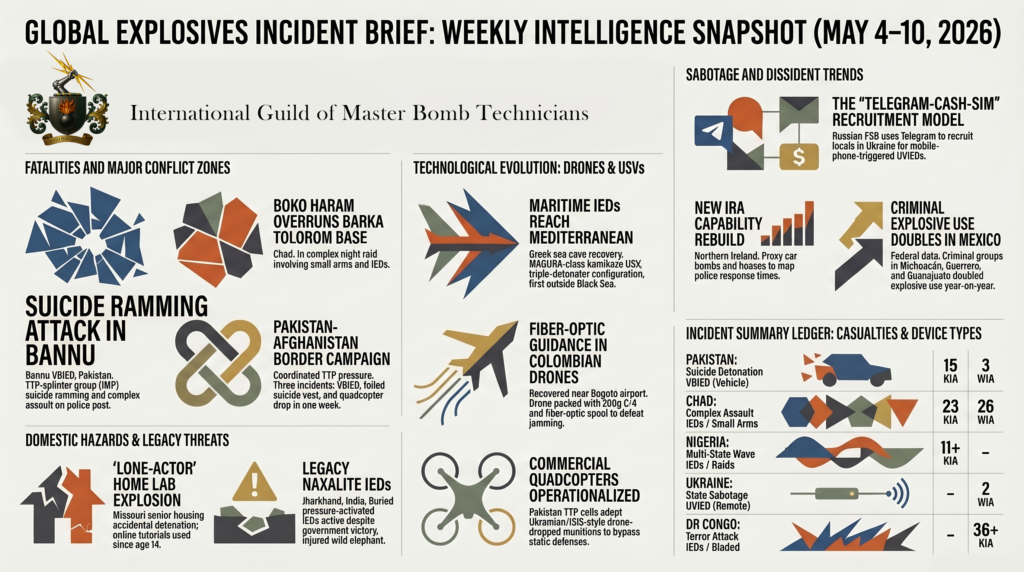
- Pakistan again the deadliest single theater. A TTP-splinter VBIED suicide attack on the Fateh Khel police post in Bannu, Khyber Pakhtunkhwa late Saturday killed 15 police officers. This was the second attack on Bannu-area security infrastructure in 72 hours, following a foiled suicide attempt in South Waziristan (5 May) and a quadcopter munitions drop in Bannu City (8 May) injuring eight. The Bannu-Waziristan corridor is now an active terror campaign zone.
- Maritime IED threat spreads beyond Black Sea. Greek fishermen recovered an apparently Ukrainian MAGURA-class USV in a sea cave off Lefkada island on 7 May, reportedly carrying 30–300 kg of explosives and triple-detonator configuration. First confirmed Ukrainian-style kamikaze USV beyond the Black Sea/Mediterranean approaches. Possible navigation failure rather than intended target.
- Drone-delivered IEDs operationalizing in Colombia and Mexico. A C-4 packed drone (260 g, PVC body, fiber-optic guidance) was recovered 7 May within strike range of Bogotá’s El Dorado International and CATAM air base. ELN and Mordisco-aligned FARC dissidents are the leading attribution. Parallel drone-borne harassment hit a Jamundí police substation 9 May. Mexican federal data over the same period show explosive use by criminal groups doubled year-on-year in Michoacán, Guerrero, and Guanajuato.
- New IRA campaign continues to materialize. Three arrests on 6 May over the 26 April Lurgan PSNI station device; reward of £20,000 offered 9 May for information on the 26 April Dunmurry proxy car bomb. A controlled disposal on a hoax device in Lisburn occurred 6–7 May. The group has publicly stated intent to target officers at their homes.
- Russia-directed contract IEDs against Ukrainian servicemen continue inside Ukraine. SBU detained two suspects in Dnipro 7 May after a remote-detonated phone-triggered IED under an AFU serviceman’s parked car wounded two. The Russian recruitment model (Telegram, cash for sabotage, suspects with no prior militant background) is now a routine baseline.
- Lake Chad Basin escalating. Boko Haram overran the Barka Tolorom island base in Chad on the night of 4–5 May, killing 23 Chadian soldiers and wounding 26. Chad declared a 20-day state of emergency on 8 May. Coordinated ISWAP/bandit activity in Borno, Zamfara, and Plateau states (Nigeria) on 8 May killed 11+.
- US homeland: small-cell and lone-actor builders persist. Federal/state forensic teams confirmed an IED-caused explosion at a Lafayette County, Missouri senior housing complex on 4 May. Suspect admitted to home-lab bomb-making since age 14. Two completed devices and chemical precursors recovered.
- Maoist (Naxalite) residual IED threat persists in India despite government victory declaration. A wild elephant was injured by a buried pressure-activated IED in Saranda forest, Jharkhand on 5 May, reaffirming that legacy devices remain emplaced despite the 30 March 2026 government claim that the insurgency is effectively over.
INCIDENT LEDGER
| # | Country | City/Area | Category | Type | Device | Target | Casualties | Confidence |
| 1 | Pakistan | Fateh Khel, Bannu, KP | Terror/ Insurgent | Detonation | VBIED (suicide) | Police post | 15 KIA, 3 WIA police | Confirmed |
| 2 | Pakistan | Azam Warsak, S. Waziristan, KP | Terror/ Insurgent | Attempted/ Foiled | Suicide vest/PBIED | Security forces’ post | 1 KIA, 15 WIA | Confirmed |
| 3 | Pakistan | Bannu, KP | Terror/ Insurgent | Detonation | Quadcopter-dropped munition | Civilian residential area | 8 WIA (incl. women) | Confirmed |
| 4 | Northern Ireland | Lurgan, Co. Armagh | Terror/ Dissident | Investigation/ Arrests | Suspected device (March incident) | Police station | 0 (3 arrests 6 May) | Confirmed |
| 5 | Northern Ireland | Lisburn, Co. Antrim | Hoax | Disruption | Elaborate hoax (controlled exp.) | Residential | 0 | Confirmed |
| 6 | Ukraine | Soborny district, Dnipro | Terror/ State-sponsored | Detonation | Under-vehicle IED (RC/phone) | AFU serviceman’s vehicle | 2 WIA | Confirmed |
| 7 | Greece | Lefkada island (sea cave) | Conflict-spillover | Discovery/ Render Safe | USV (MAGURA-class, multi-detonator) | Maritime (intended) | 0 | Probable |
| 8 | Colombia | Kennedy district, Bogotá | Terror/ Insurgent | Discovery/ Render Safe | FPV drone w/ 260 g C-4, fiber-optic | El Dorado Intl / CATAM AB | 0 | Confirmed |
| 9 | Colombia | Potrerito, Jamundí (Valle) | Terror/ Insurgent | Detonation | Drone-dropped explosive(s) | Police substation | 2 WIA police | Confirmed |
| 10 | Colombia | Valdivia, Antioquia (Hwy) | Terror/ Insurgent | Detonation + Arson | Suspected cylinder bomb + IED | Civilian highway / vehicles | 0 reported | Probable (ELN attributed) |
| 11 | Chad | Barka Tolorom island, L. Chad | Terror/ Insurgent | Complex attack | Small arms + IEDs (BH SOP) | Military post | 23 KIA, 26 WIA soldiers | Confirmed |
| 12 | Nigeria | Borno, Zamfara, Plateau | Terror/ Insurgent | Multiple detonations | IEDs + small arms (ISWAP/bandits) | Civilians, military | 11+ KIA | Confirmed |
| 13 | Nigeria | Borno (Damboa axis) | Counter-IED | Recovery/ RSP | 4 roadside IEDs | Civilian traffic / convoy | 0 (recovered) | Confirmed |
| 14 | Nigeria | Maiduguri, Borno | Counter-IED | RSP | Backpack-concealed IED | Civilian area | 0 (detonated safely) | Confirmed |
| 15 | Nigeria | Enugu | Counter-Insurgent | Cache find | Multiple IEDs (alleged IPOB) | n/a | 0 | Probable |
| 16 | USA | Odessa, Lafayette Co., MO | Criminal | Detonation (accidental) | Homemade IED (in residence) | Apartment (self-inflicted) | 0 WIA | Confirmed |
| 17 | India | Saranda forest, Jharkhand | Legacy Insurgent | Detonation | Pressure-activated buried IED | Convoy ambush emplacement | 1 wild elephant WIA | Confirmed |
| 18 | DR Congo | Beni Mau / Mama-Neema, N. Kivu | Terror/ Insurgent | Multiple | IEDs + bladed weapons (ADF) | Civilian villages | 36+ KIA (2 days) | Probable |
INCIDENT CARDS
CARD 1: Fateh Khel Police Post VBIED Suicide Attack (Bannu, Pakistan)
Location/Time: Fateh Khel police post, Bannu district, Khyber Pakhtunkhwa, Pakistan | ~2055 local (1555 GMT) | Saturday 9 May 2026 (death toll figures reported through 10 May)
Category / Context: Terror/Insurgent — claimed by Ittehad-ul-Mujahideen Pakistan (IMP), assessed by Pakistani authorities as a TTP front
Incident Type: Detonation (complex attack: VBIED suicide ram followed by gunmen)
Incident Summary (TTP-focused): A suicide bomber rammed an explosive-laden vehicle into the perimeter of the Fateh Khel post during evening hours. The blast destroyed the facility structure; armed attackers reportedly followed up with small-arms fire before being repelled. The post functions as a forward checkpoint along a known TTP infiltration corridor between Bannu City and North Waziristan. Pattern matches prior Bannu-area VBIED-plus-assault complex attacks against Pakistani security infrastructure throughout 2025–2026.
- Device Type: VBIED (vehicle-borne, suicide-driven)
- Delivery & Placement: Vehicle rammed perimeter / gate area
- Initiation Method: Driver-initiated (suicide)
- Target Type: Fixed police post (forward operating)
- Effects: 15 police KIA, 3 WIA; structure destroyed
- Suspected Perpetrator: Ittehad-ul-Mujahideen Pakistan claimed responsibility. Pakistani officials assess IMP as a TTP rebranding/splinter operating with TTP material and operational support. High confidence in TTP-network attribution.
- Confidence: Confirmed
- Source Reliability: High (multiple wire services, Counter-IED Report, Pakistani official statements)
Sources:
- Counter-IED Report — “Pakistan: 15 police personnel killed in Bannu suicide attack” — 10 May 2026
- Washington Post — “Death toll rises to 14 in Pakistan suicide attack. Pakistani Taliban splinter group claims blast” — 10 May 2026
- Xinhua — “At least 15 police personnel killed in suicide bomber attack in Pakistan” — 11 May 2026
- Pakistan Today — “Suspected suicide attack targets Bannu police post” — 10 May 2026
- Organiser — “Pakistan: 15 policemen killed, 3 injured in suicide attack by TTP” — 11 May 2026
Analyst Note: The “Ittehad-ul-Mujahideen Pakistan” branding is consistent with TTP’s broader 2025–2026 fragmentation playbook — claim attacks under new banners to muddy attribution and complicate Pakistani diplomatic pressure on Kabul. EOD/CT watch points for next 1–2 weeks: (1) repeat VBIED attacks on Bannu-corridor posts using stolen or coerced civilian vehicles; (2) follow-on small-arms element appearing in more attacks (signature complex assault); (3) Pakistani retaliatory cross-border strike likely, which historically triggers further TTP escalation.
CARD 2: Foiled Suicide Attack on Azam Warsak Post (South Waziristan, Pakistan)
Location/Time: Near Azam Warsak Bazaar, South Waziristan, Khyber Pakhtunkhwa, Pakistan | Monday evening | 4–5 May 2026
Category / Context: Terror/Insurgent — attribution to TTP-aligned faction (not formally claimed)
Incident Type: Attempted / Disrupted
Incident Summary: A bomber approached a security forces’ post and was engaged before reaching the perimeter. Initiation occurred, but kinetic stand-off and target hardening contained the effect. One person (assessed as bomber or guard) was killed; 15 personnel sustained injuries. The post had been previously identified as a target based on prior surveillance activity, allowing pre-emptive posture.
- Device Type: Suicide-borne (PBIED/vest assessed, not formally confirmed)
- Delivery & Placement: On-foot approach to post perimeter
- Initiation Method: Suicide-initiated; details on whether device fully or partially functioned not disclosed
- Target Type: Fixed security forces’ post
- Effects: 1 KIA, 15 WIA
- Suspected Perpetrator: TTP or aligned faction; no formal claim in open sources at time of brief
- Confidence: Confirmed (Pakistani security sources, multiple outlets)
- Source Reliability: Medium-High (Pakistani security sourcing; full forensic details not released)
Sources:
- Counter-IED Report — “Pakistan: One killed, 15 injured in foiled suicide attack in South Waziristan” — 5 May 2026
Analyst Note: Pairs directly with CARD 1. Same operational corridor, same operational week, same target set (fixed security infrastructure). The foiled-then-successful sequence supports a campaign assessment rather than two independent incidents. TTP cells appear to be probing multiple posts simultaneously to identify lower-vigilance targets. Bomb techs supporting the Pakistani C-IED effort should expect a continued tempo of one VBIED or PBIED per 72 hours in the Bannu-South Waziristan band into late May.
CARD 3: Quadcopter Munitions Drop in Bannu (KP, Pakistan)
Location/Time: Bannu district, Khyber Pakhtunkhwa, Pakistan | Friday night | 8 May 2026
Category / Context: Terror/Insurgent — TTP-aligned (attribution per Counter-IED Report)
Incident Type: Detonation (UAS-delivered)
Incident Summary: A quadcopter dropped an explosive payload over a civilian-occupied area in Bannu, producing a powerful explosion. Eight people were injured, including women. This is consistent with the broader 2025–2026 TTP trend of adapting commercial-grade quadcopters and drone-dropped munitions previously seen on the Ukrainian and ISIS battlefields.
- Device Type: Improvised drone-dropped munition (specific filler / fragmentation profile not disclosed)
- Delivery & Placement: UAS overflight; release over target area
- Initiation Method: Drop/impact (assessed); possibly altimetric fuze
- Target Type: Civilian residential area (intent: terror/coercion)
- Effects: 8 WIA including women
- Suspected Perpetrator: TTP / TTP-aligned faction
- Confidence: Confirmed
- Source Reliability: Medium-High (Counter-IED Report aggregation; Pakistani local press)
Sources:
- Counter-IED Report — “Pakistan: Quadcopter attack in KP’s Bannu injures 8, including women” — 8 May 2026
Analyst Note: Three incidents in the same district within one week — VBIED, foiled suicide, drone-drop — argues for a coordinated TTP pressure campaign on Bannu. The drone-drop element matters most for C-IED: it raises the cost of static defense, defeats most blast walls, and is materially cheaper than a VBIED. Pakistani security units operating at fixed posts in the band need RF/CUAS overwatch in addition to standoff and PPE. Watch for: copycat drone-drop attacks against military, police, or polling stations during upcoming KP electoral activity.
CARD 4: Three Arrests over Lurgan PSNI Station Device (Northern Ireland)
Location/Time: Lurgan, County Armagh, Northern Ireland | Investigation arrests Wednesday 6 May 2026 (referencing earlier March 2026 attack)
Category / Context: Terror/Dissident Republican (New IRA assessed)
Incident Type: Investigation / Arrests (no new detonation this week)
Incident Summary: PSNI announced the arrests of three people, including a teenage boy, in connection with a March 2026 device attack on a Lurgan police station. The original device, which was the subject of the investigation, was disarmed. Investigation continues into the device’s construction, emplacement, and operational cell.
- Device Type: Disarmed device (full construction not disclosed; consistent with dissident republican typology — likely under-vehicle or projected device based on prior patterns)
- Delivery & Placement: Police station target
- Initiation Method: Not disclosed
- Target Type: Police station
- Effects: None to persons; police arrest activity
- Suspected Perpetrator: New IRA (consistent with concurrent claims)
- Confidence: Confirmed (PSNI announcement)
- Source Reliability: High (Counter-IED Report aggregation, court reporting)
Sources:
- Counter-IED Report — “Northern Ireland: Teenager among three people arrested over Lurgan police station car bomb attack” — 6 May 2026
Analyst Note: Combined with the Dunmurry investigation activity this week (reward offered 9 May; charges including attempted murder) and the Lisburn hoax 6–7 May, dissident republican operational tempo in Northern Ireland is well above the post-Good Friday Agreement baseline. The pattern — successful proxy car bomb against a PSNI station, public group claim, threat to escalate to officers’ homes, parallel disarmed device with under-18 cell member — argues that the New IRA is rebuilding capability and recruitment, not just claiming individual incidents. C-IED priorities: PSNI station perimeter standoff, vehicle hijack reporting workflows, officers’ off-duty pattern-of-life security.
CARD 5: Lisburn Hoax Device (Northern Ireland)
Location/Time: Hillview Avenue, Lisburn, County Antrim, Northern Ireland | Operation began evening 6 May 2026; concluded 7 May 2026
Category / Context: Hoax (assessed as deliberate)
Incident Type: Disruption / Hoax (controlled disposal conducted)
Incident Summary: PSNI cordoned a residential area after a suspicious object was reported. Ammunition Technical Officers (ATOs) attended, examined the item, and conducted a controlled explosion. Object was subsequently deemed an “elaborate hoax.” Local residents were evacuated and returned home after the all-clear.
- Device Type: Hoax (form factor designed to compel ATO callout)
- Delivery & Placement: Residential area emplacement
- Initiation Method: N/A (hoax)
- Target Type: Disruption of PSNI/ATO resources; intimidation of community
- Effects: No injuries; ATO/PSNI resource diversion
- Suspected Perpetrator: Not formally attributed; consistent with dissident republican hoax operational tempo
- Confidence: Confirmed (PSNI official statement)
- Source Reliability: High
Sources:
- Northern Ireland World — “Lisburn: Residents return home after suspect device declared ‘elaborate hoax’”
- 4ni.co.uk — “Lisburn Security Alert Ends After Device Declared An Elaborate Hoax” — 7 May 2026
Analyst Note: “Elaborate” hoaxes are not random — they are typically used to map ATO response cycle times, identify cordon SOPs, and condition the C-IED workforce. Pair this hoax with the genuine Dunmurry and Lurgan attacks and a tempo pattern emerges: real device → hoax → real device. Bomb techs should not relax cordon discipline on declared hoaxes; the next call may be a viable device emplaced to exploit a relaxed posture.
CARD 6: Under-Vehicle IED Targeting AFU Serviceman (Dnipro, Ukraine)
Location/Time: Soborny district, Dnipro, Ukraine | ~0730 local | Thursday 7 May 2026
Category / Context: Terror / State-sponsored sabotage (Russian FSB-directed)
Incident Type: Detonation
Incident Summary: A parked vehicle owned by a Ukrainian Armed Forces serviceman was destroyed by an under-vehicle improvised explosive device. Per SBU investigators, the device had been emplaced overnight by two contracted operatives who set up a separate mobile phone-based camera to record the strike, then remotely triggered the IED via a phone call to a SIM-rigged detonator. The pair were recruited via Telegram channels offering quick cash for sabotage, with payment routed from Russian handlers. One suspect was detained while attempting to flee the country. Two civilians were wounded.
- Device Type: Under-vehicle IED (UVIED); RC initiation
- Delivery & Placement: Emplaced under parked private vehicle of military target
- Initiation Method: Remote — phone call to SIM-rigged detonator (low-cost RCIED)
- Target Type: Individual AFU serviceman
- Effects: Vehicle destroyed; 2 WIA
- Suspected Perpetrator: Two Ukrainian nationals contracted by Russia (per SBU); FSB direction assessed
- Confidence: Confirmed
- Source Reliability: High (SBU official, multiple Ukrainian/international outlets)
Sources:
- Counter-IED Report — “Ukraine: Two suspects in custody after vehicle targeted by IED explosion in Dnipro” — 8 May 2026
- The New Voice of Ukraine — “SBU detains two suspects in connection with contract killing of soldier in Dnipro”
- Liveuamap — “2 people wounded as result of car explosion in Dnipro” — 7 May 2026
Analyst Note: The Russian “Telegram-cash-SIM-trigger” model is now mature and reproducible. Cost per attempted strike is in the low hundreds of dollars. Watch points: (1) the camera-and-livestream component — Russia is increasingly treating these strikes as propaganda assets, which incentivizes higher tempo; (2) the recruitment funnel skews young, financially desperate, and apolitical — vetting profiles in Ukrainian counter-sabotage messaging should adjust to that demographic; (3) similar contracted-by-adversary IED models are surfacing in NATO Baltic states and Poland (see Atlantic Council reporting). The Dnipro signature should be a baseline reference card for police/EOD across the Eastern flank.
CARD 7: Magura-Class USV Recovered in Sea Cave (Lefkada, Greece)
Location/Time: Sea cave, west coast of Lefkada island, Ionian Sea, Greece | Found by fishermen Thursday evening | 7 May 2026; investigation continuing through 9 May
Category / Context: Conflict-spillover (Ukraine-Russia maritime drone warfare, likely navigation drift)
Incident Type: Discovery / Render Safe (ongoing as of brief)
Incident Summary: Greek fishermen exploring coastal sea caves on Lefkada discovered a black-hulled unmanned surface vessel (USV) carrying explosives. Initial forensic analysis assessed the platform as a MAGURA V3-class kamikaze USV. Open-source reporting on the explosive load is inconsistent — initial reports cite ~30 kg, subsequent reports up to ~300 kg; specialists confirmed at least three detonators rigged for explosive employment. The vessel is assessed as having drifted from its operational area off the Russian Black Sea Fleet’s deployment zones, with experts citing satellite navigation or comms-link failure as the most likely cause.
- Device Type: Maritime kamikaze USV (improvised in operational terms; manufactured platform)
- Delivery & Placement: Self-propelled USV; drifted to recovery point
- Initiation Method: Multiple detonators (impact/command — exact mode not disclosed)
- Target Type: (Intended) Russian-flagged or Russia-linked maritime traffic in eastern Mediterranean / Black Sea approaches
- Effects: None to persons or property; pending render safe
- Suspected Perpetrator: Ukrainian intelligence / Defense Forces (MAGURA platform attribution)
- Confidence: Probable (platform attribution confirmed by multiple sources; intended mission/target inferred)
- Source Reliability: Medium-High (Greek defense reporting + Naval News; some explosive-mass discrepancy)
Sources:
- Counter-IED Report — “Greece: Explosive-laden drone vessel discovered off Lefkada disarmed by specialists” — 8 May 2026
- Greek City Times — “Ukrainian Sea Drone Loaded with 300kg of Explosives Found in Lefkada – Targeted Russian Ship in Ionian Sea” — 9 May 2026
- Naval News — “Mystery USV Possibly Linked to Ukraine Found by Greek Fishermen” — May 2026
- ProtoThema English — “Concern in the Hellenic Armed Forces over the armed drone boat in Lefkada” — 9 May 2026
Analyst Note: First publicly documented USV recovery outside the Black Sea / Sea of Azov / Russian Black Sea coastline. This matters for three reasons: (1) it pushes the operational reach of maritime improvised explosive systems hundreds of nautical miles further into NATO littoral waters; (2) it sets a precedent for nation-state-grade IEDs washing up in civilian areas, where local fishermen or coast guards may handle them without C-IED training; (3) the explosive-mass discrepancy in open reporting (30 vs 300 kg) is a useful reminder to bomb techs to verify primary forensics rather than rely on early media. Eastern Mediterranean coast guards should pre-position render-safe doctrine for drifting USVs as a baseline contingency.
CARD 8: C-4 Drone Recovery near El Dorado / CATAM AB (Bogotá, Colombia)
Location/Time: Kennedy district, woodland near Bogotá River, Bogotá D.C., Colombia | Recovered Wednesday afternoon | 6–7 May 2026 (reporting 7–8 May)
Category / Context: Terror/Insurgent — ELN or Mordisco-FARC dissidents assessed
Incident Type: Discovery / Render Safe
Incident Summary: Colombian National Police anti-terror units, working with Colombian Aerospace Force specialists, recovered an explosive-laden drone less than 6 km from El Dorado International Airport and the adjoining CATAM Military Air Transport Command base. The payload comprised 260 g of military-grade C-4 packed in a PVC tube with a medical-syringe-rigged detonator and an onboard camera for terminal guidance. A fiber-optic guidance spool was integrated, mirroring tactics observed in Catatumbo and Cauca where ELN and Iván Mordisco-aligned FARC dissident cells operate. The platform crashed without functioning.
- Device Type: Explosive-laden multirotor UAS with fiber-optic guidance link
- Delivery & Placement: Aerial; intended terminal flight on target
- Initiation Method: Camera-guided FPV; detonator triggered on impact / command (artisanal mine signature)
- Target Type: Strategic aviation infrastructure (El Dorado International, CATAM AB)
- Effects: None (recovered intact-ish, render safed)
- Suspected Perpetrator: ELN or Mordisco-FARC dissidents; no formal claim
- Confidence: Confirmed (recovery + Colombian National Police statement)
- Source Reliability: High (multiple Colombian and international outlets, military attribution)
Sources:
- Counter-IED Report — “Colombia: Explosive-Laden Drone of Unknown Origin Crashes Near Bogotá’s El Dorado Airport” — 8 May 2026
- Colombia One — “Drone Carrying Explosives Found Near El Dorado Airport and Colombian Air Force Base in Bogota” — 7 May 2026
- The City Paper Bogotá — “Explosive Drone Deactivated Near Bogotá’s El Dorado International Airport”
- Infobae Colombia — “Este es el grupo criminal que estaría detrás del dron con explosivos hallado cerca de El Dorado y Catam” — 8 May 2026
Analyst Note: Three things stand out. First, the fiber-optic guidance integration — straight transfer of Ukraine-war TTP into a Latin American insurgent toolkit, defeating most RF-based CUAS. Second, the payload (260 g C-4) is sufficient for a precision strike on softskin targets but not a mass-casualty airport attack — the platform looks built for targeted assassination or symbolic damage rather than civilian airport disruption. Third, the timing — three weeks before the 31 May 2026 Colombian presidential election — makes a campaign-disruption motive plausible. Watch points: more drone recoveries in the Bogotá metro area in the lead-up to the vote; ELN/Mordisco public statements indicating responsibility post-vote; potential follow-on attacks on candidate convoys.
CARD 9: Drone Attack on Potrerito Police Substation (Jamundí, Colombia)
Location/Time: Potrerito, rural Jamundí, Valle del Cauca, Colombia | Saturday morning | 9 May 2026
Category / Context: Terror/Insurgent — local FARC dissident or ELN-aligned
Incident Type: Detonation (drone-borne harassment)
Incident Summary: A police substation in the Potrerito jurisdiction of Jamundí was harassed by what local press described as drone-based explosive attack(s). Material damage to the substation, two officers wounded by shrapnel. Pattern fits ongoing Valle del Cauca FARC-dissident harassment campaigns against fixed police infrastructure.
- Device Type: Drone-dropped or drone-delivered explosive (specific construction not disclosed)
- Delivery & Placement: Aerial / drop or impact
- Initiation Method: Impact / altimetric / command (not disclosed)
- Target Type: Rural police substation
- Effects: 2 WIA police (shrapnel), material damage
- Suspected Perpetrator: Not formally attributed; Valle del Cauca FARC dissidents/ELN profile-consistent
- Confidence: Confirmed (Colombian press)
- Source Reliability: Medium-High
Sources:
- El País Colombia — “Nuevo ataque con explosivos contra la subestación de Policía de Potrerito, zona rural de Jamundí”
Analyst Note: Two Colombian drone-explosive events in a single week — one against strategic capital airspace (CARD 8), one against rural police infrastructure — signal the maturation of armed-UAS-IED as a routine TTP for Colombian non-state actors. Colombian C-IED and police EOD doctrine needs to assume drone delivery is now a default vector, not a novelty.
CARD 10: ELN Highway IED + Vehicle Burning (Valdivia, Antioquia, Colombia)
Location/Time: Highway between Valdivia and Tarazá, northern Antioquia, Colombia | Early morning Sunday | 10 May 2026
Category / Context: Terror/Insurgent — ELN (flag found on scene)
Incident Type: Detonation + arson + IED emplacement (combined road denial / corridor attack)
Incident Summary: Armed men intercepted vehicles at a strategic point on the Medellín–Caribbean coast corridor. One Coonorte bus and two truck-trailers were set on fire. Authorities recovered an ELN flag and a suspected improvised explosive device (a “suspicious cylinder”) at the scene; the cylinder was destroyed by EOD on site to avoid risk to the civilian population. No casualties reported, but the road was closed and traffic suspended.
- Device Type: Improvised cylinder bomb (gas cylinder filled with explosive/shrapnel — ELN signature)
- Delivery & Placement: Roadside / staged at intercept point
- Initiation Method: Not disclosed; ELN cylinder bombs are commonly command-detonated or timer-set
- Target Type: Civilian vehicles + corridor denial
- Effects: Vehicles destroyed; corridor closed
- Suspected Perpetrator: ELN (flag recovered on scene)
- Confidence: Probable-to-Confirmed (ELN flag is signature but not formal claim)
- Source Reliability: High (Colombian press)
Sources:
- Infobae Colombia — “Hombres armados incineraron tres vehículos en la vía Medellín – Costa Atlántica” — 10 May 2026
- El Tiempo — “El Eln incineró un bus y dos camiones e instaló un explosivo en la vía entre Medellín y costa Caribe”
Analyst Note: The ELN signature gas-cylinder IED remains operationally dominant in Antioquia. The pre-election timing (CARD 8, 9, 10 all within 21 days of presidential vote) and the corridor-denial choice of target reinforce a strategic posture: ELN is signaling, not seeking mass casualties. The arson-plus-IED combination — fire to attract first responders, IED to target them — is a known second-stage hazard. Colombian EOD/firefighter coordination cells should be on heightened second-device alert for the rest of May.
CARD 11: Boko Haram Overrun of Barka Tolorom Base (Lake Chad, Chad)
Location/Time: Barka Tolorom island, Lake Chad region, Chad | Night of Monday 4 May into early Tuesday 5 May 2026
Category / Context: Terror/Insurgent — Boko Haram / JAS faction
Incident Type: Complex attack (small arms + IED component per BH SOP)
Incident Summary: Boko Haram fighters assaulted a Chadian Army military post on Barka Tolorom island. Chadian armed forces reported 23 soldiers killed and 26 injured. Government communications described the post as overrun before counterattack repelled remaining attackers; a “significant number” of attackers were killed. Chad declared a 20-day state of emergency in the Lake Chad region 8 May. Boko Haram’s standard complex-attack TTP combines IED emplacement on access routes, small-arms assault element, and harassing indirect fire.
- Device Type: Multiple — VBIED/IED entry tactics common in BH SOP; specific device inventory not disclosed in open sources
- Delivery & Placement: Combined ground assault on fixed base
- Initiation Method: Not disclosed for IED component
- Target Type: Fixed military post
- Effects: 23 KIA, 26 WIA Chadian soldiers
- Suspected Perpetrator: Boko Haram (JAS faction, dominant in this lake sector)
- Confidence: Confirmed (Chadian government statement, multiple wire outlets)
- Source Reliability: High
Sources:
- Counter-IED Report — “Chad: Boko Haram militants kill 23 soldiers in an attack on a military post in the Lake Chad region” — 5 May 2026
- Washington Post — “Boko Haram militants kill 23 soldiers in an attack on a military post, Chad says” — 5 May 2026
- Al Jazeera — “Chad declares national mourning after deadly Boko Haram ambush” — 7 May 2026
- Xinhua — “23 killed in Boko Haram attack in Chad” — 5 May 2026
- CGTN — “Chad declares state of emergency after deadly Boko Haram attacks” — 8 May 2026
Analyst Note: The Lake Chad operational tempo is back to its 2021–2022 peak — coordinated assaults capable of overrunning fixed infantry positions are not isolated incidents. Counter-IED implications: roadside IEDs on response and reinforcement routes are a near-certainty for the follow-on attack cycle; Boko Haram historically exploits the second wave to inflict additional casualties on relief columns. Multinational Joint Task Force (Chad/Nigeria/Niger/Cameroon) bomb techs should expect a sustained 4–6 week elevated operational tempo. Watch points: parallel attacks on the Nigerian side of the lake (which see CARD 12); Cameroonian Far North incidents likely.
CARD 12: Coordinated Attacks across Borno, Zamfara, Plateau (Nigeria)
Location/Time: Multiple sites in Borno, Zamfara, and Plateau states, Nigeria | Friday | 8 May 2026
Category / Context: Terror/Insurgent — ISWAP (Borno), armed bandits (Zamfara), inter-communal/jihadist (Plateau)
Incident Type: Multiple detonations + complex attacks
Incident Summary: A wave of coordinated attacks across three Nigerian states left at least 11 confirmed dead with several injured. Attribution distributed across ISWAP (Borno), bandit “unknown gunmen” formations (Zamfara), and Plateau communal/jihadist activity. The Borno operations include IED employment by ISWAP cells, consistent with the wider New Marte and Damboa-axis activity surge documented from late April through 22 May 2026.
- Device Type: IEDs + small arms (combined arms TTP)
- Delivery & Placement: Roadside emplacement (Borno); harassment in Zamfara; village-targeted raids in Plateau
- Initiation Method: Mixed (CWIED, VOIED roadside, command-detonated)
- Target Type: Mixed: military posts, civilian villages, transport routes
- Effects: 11+ KIA confirmed; broader civilian casualties under-reported
- Suspected Perpetrator: ISWAP (Borno); armed bandits (Zamfara); jihadist/communal (Plateau)
- Confidence: Confirmed (Counter-IED Report)
- Source Reliability: Medium-High (regional press, military communiques)
Sources:
- Counter-IED Report — “Nigeria: A wave of coordinated attacks hit Borno, Zamfara and Plateau states” — 8 May 2026
Analyst Note: Pair with the New Marte / Damboa-axis ISWAP campaign reported by the Soufan Center (early May ISWAP overrun of 50 Task Force Battalion, theft of 45 vehicles, attacks on Dikwa and Rann). This week’s events are consistent with ISWAP’s broader 2026 strategy of distributing pressure across the Nigerian-Chadian basin simultaneously to overstretch MNJTF response. EOD/C-IED priorities for the next four weeks: expect roadside IED ambushes targeting reinforcement columns; expect VBIED attacks against fixed bases; expect stolen-vehicle conversion to VBIED is now a baseline assumption given New Marte vehicle losses.
CARD 13: Roadside IEDs Recovered Damboa Axis (Borno, Nigeria)
Location/Time: Damboa axis, Borno State, Nigeria | Reported 8 May 2026
Category / Context: Counter-IED — successful recovery and disposal
Incident Type: Recovery / Render Safe (4 devices)
Incident Summary: Nigerian Army 202 Battalion EOD teams recovered and destroyed four roadside IEDs planted along a Borno roadway. Devices were positioned for convoy/vehicular targeting on the Damboa axis — a known ISWAP/Boko Haram lane.
- Device Type: Roadside IEDs (specific construction not disclosed)
- Delivery & Placement: Roadside / buried (consistent with axis pattern)
- Initiation Method: Not disclosed (likely VOIED pressure-plate or command-pull)
- Target Type: Convoy/vehicular
- Effects: None — recovered safely
- Suspected Perpetrator: ISWAP / Boko Haram
- Confidence: Confirmed
- Source Reliability: High (Nigerian Army release via Counter-IED Report)
Sources:
- Counter-IED Report — “Nigeria: Troops recover, destroy four IEDs in Borno” — 8 May 2026
Analyst Note: Successful recoveries are the silent baseline of effective C-IED — they don’t make the headlines but they prevent the headlines. Four devices on a single axis in one operation indicates ISWAP is investing emplacement resources in this corridor. Expect concentrated IED density on Damboa-Maiduguri routes through the rest of May. The successful render-safe outcome supports continued investment in Nigerian Army EOD training and equipping.
CARD 14: Backpack-Concealed IED Detonated in Maiduguri (Borno, Nigeria)
Location/Time: Layin Logo, Moduganari area, Maiduguri, Borno State, Nigeria | Tuesday | 5 May 2026
Category / Context: Counter-IED — police render-safe
Incident Type: Disruption (controlled detonation)
Incident Summary: Borno State Police EOD operatives located and detonated an IED concealed inside a backpack in a populated area of Maiduguri. The Public Relations Officer confirmed the device was made safe with no civilian casualties.
- Device Type: Person-borne / left-in-place backpack IED (PBIED-style emplacement)
- Delivery & Placement: Concealed and abandoned in public space; signature consistent with Boko Haram/ISWAP urban tactic
- Initiation Method: Not disclosed (could be timer/command)
- Target Type: Civilian-populated area (terror objective)
- Effects: None — disposed safely
- Suspected Perpetrator: ISWAP / Boko Haram (presumed based on locale and method)
- Confidence: Confirmed
- Source Reliability: High (Nigerian police statement)
Sources:
- Counter-IED Report — “Nigeria: Police uncover, neutralise IED in Borno” — 5 May 2026
Analyst Note: Backpack-concealed urban IEDs in Maiduguri remain a chronic threat. Successful pre-detonation neutralization in Layin Logo indicates either operational intelligence or community reporting worked correctly — both are leading indicators of resilient civil-security cooperation in the city. Continue to expect similar emplacements in mid-2026, especially around markets and bus parks.
CARD 15: IEDs Recovered from Suspected IPOB Hideout (Enugu, Nigeria)
Location/Time: Enugu state, Nigeria | Reported 8 May 2026
Category / Context: Counter-Insurgent — cache find at suspected IPOB site
Incident Type: Cache find / Recovery
Incident Summary: Nigerian Army Sector 1, Operation UDO KA, raided what was described as a suspected ritual shrine and IPOB (Indigenous People of Biafra) hideout, recovering improvised explosive devices and other materials. No detonation event.
- Device Type: Multiple IEDs (specifics not disclosed)
- Delivery & Placement: Cached / pre-emplacement
- Initiation Method: N/A (cached)
- Target Type: N/A (cache)
- Effects: None
- Suspected Perpetrator: IPOB (Nigerian Army characterization)
- Confidence: Probable (military statement; IPOB has historically disputed Nigerian Army characterizations of South-East cache finds)
- Source Reliability: Medium (single-source military release)
Sources:
- Counter-IED Report — “Nigeria: Army recovers IEDs from IPOB hideout in Enugu” — 8 May 2026
Analyst Note: The South-East Nigeria IED picture is murky in open sources because Nigerian military and IPOB-aligned voices disagree sharply on attribution. The find itself is real; the IPOB attribution is plausible but not independently corroborated. Counter-IED takeaway: continued IED activity in the South-East requires bomb techs to be operationally fluent in multiple political contexts (Lake Chad jihadist vs. South-East ethnic-political vs. North-West banditry — different doctrines, different signatures).
CARD 16: Homemade IED Explosion at Senior Housing (Odessa, Missouri, USA)
Location/Time: 200 block of Otway Street, Odessa, Lafayette County, Missouri, USA | ~0400 local | Monday 4 May 2026
Category / Context: Criminal (lone-actor builder; meth involvement)
Incident Type: Detonation (accidental self-inflicted in builder’s residence)
Incident Summary: An explosion in a federally subsidized senior housing apartment was initially treated as a natural gas event. State and federal investigators (Missouri State Fire Marshal, ATF, Missouri Highway Patrol Bomb Squad) determined the explosion was caused by “chemicals associated with an improvised explosive device.” A search of the apartment recovered two completed homemade IEDs, IED precursor chemicals and tools, methamphetamine, and two unlawfully-possessed firearms (an AR-15 with serial removed and a 12-gauge shotgun). Resident Stanley E. Box was arrested. Box admitted to operating a home bomb-making lab since age 14, sourced from online tutorials. He told investigators he was attempting to build a “big firework.” No casualties.
- Device Type: Homemade IED(s); specific filler/fuze not publicly disclosed
- Delivery & Placement: In-residence build (self-inflicted incident)
- Initiation Method: Accidental during build
- Target Type: None identified — builder denies attack intent (claims “big firework”)
- Effects: Building damage, no injuries
- Suspected Perpetrator: Stanley E. Box (charged)
- Confidence: Confirmed (federal/state forensic confirmation)
- Source Reliability: High (multiple US outlets, ATF/Bomb Squad statements)
Sources:
- Counter-IED Report — “Missouri: Suspect arrested after improvised explosive device explosion Monday in Odessa” — 5 May 2026
- KCTV5 — “Apartment explosion exposes homemade bomb lab in Missouri senior living complex”
- Fox4KC — “Man arrested, charged in Odessa apartment explosion wanted to make ‘big firework’”
- BNO News — “Missouri man accused of making IEDs after blast at senior housing complex”
- KSHB — “Man charged in Odessa explosion told police he was making a ‘big firework’”
Analyst Note: “Big firework” is a recurring statement pattern from lone-actor builders post-incident. It is meaningfully different from “I was going to attack X.” For prosecutors, the question becomes intent versus capability — and the homemade-tutorial admission (since age 14) speaks to capability accumulation regardless of stated intent. US ATF and local bomb squads should treat senior-housing and rural-residential builders as a routine threat category, not a novelty: the precursor accumulation and informal community make them hard to detect until the inevitable build-error event. Watch for parallel domestic precursor-acquisition arrests in coming weeks.
CARD 17: Maoist Legacy IED Injures Wild Elephant (Saranda forest, Jharkhand, India)
Location/Time: Saranda forest, West Singhbhum district, Jharkhand, India | Reported 5 May 2026
Category / Context: Legacy Insurgent — emplaced device, post-counter-insurgency campaign
Incident Type: Detonation (non-human casualty)
Incident Summary: A wild elephant stepped on a pressure-activated IED concealed in a mud forest road and was injured. The device had been emplaced by Maoist (Naxalite) elements as a convoy ambush tool prior to the 30 March 2026 government victory declaration. The incident underscores that significant numbers of emplaced devices remain in forest tracts despite the operational defeat of the insurgent leadership.
- Device Type: Pressure-activated buried IED (VOIED)
- Delivery & Placement: Buried in dirt forest road
- Initiation Method: Victim-operated (pressure plate)
- Target Type: Originally — security forces convoy; actual victim — wildlife
- Effects: 1 elephant WIA
- Suspected Perpetrator: CPI (Maoist) — legacy emplacement
- Confidence: Confirmed (Indian government, Counter-IED Report)
- Source Reliability: High
Sources:
- Counter-IED Report — “India: Wild elephant injured after stepping on a suspected Maoists’ IED in Saranda forest” — 5 May 2026
Analyst Note: The Naxal “victory” announcement was about the leadership and active operational presence, not about emplaced infrastructure. India is now facing a Cambodia-scale ERW residual problem in forest tracts. Long-term implication: humanitarian demining and clearance capacity in Chhattisgarh, Jharkhand, and Odisha must be funded and built out, or the post-conflict casualty curve (currently mostly wildlife and accidental civilian) will continue for years. Watch points: government clearance program announcements; international demining NGO entry into the theater.
CARD 18: ADF Attacks in Beni Mau / Mama-Neema (North Kivu, DRC)
Location/Time: Villages near Beni Mau (North Kivu) and Mama-Neema area, eastern Democratic Republic of Congo | Tuesday-Wednesday | 5–6 May 2026 (continuing through 7 May)
Category / Context: Terror/Insurgent — ADF (ISCAP-affiliated)
Incident Type: Complex attacks (small arms + bladed weapons; IEDs along roads recorded in parallel)
Incident Summary: Allied Democratic Forces (ADF) fighters attacked four isolated villages near Beni Mau in North Kivu overnight Tuesday-Wednesday, killing at least 21. Cumulative two-day death toll reported at 36+, with regional ACLED-tracked totals climbing toward 69+ over the week. Three IED detonations were reported on roads between Mayi-Safi and Mama-Neema during the same period, consistent with ADF’s roadside ambush TTP against responding Congolese forces. Primary kinetic instrument remains light arms and machetes; IED component appears focused on lines of communication denial.
- Device Type: Roadside IEDs (alongside small-arms primary)
- Delivery & Placement: Buried/concealed on access roads
- Initiation Method: VOIED / command (not disclosed per-incident)
- Target Type: Civilians (villages); Congolese forces (roads)
- Effects: 36+ civilian KIA confirmed (two-day count); 69+ over week per regional reporting
- Suspected Perpetrator: ADF
- Confidence: Probable for IED-specific component; Confirmed for ADF attacks broadly
- Source Reliability: Medium-High (Africanews, Al Jazeera, Amnesty regional reporting)
Sources:
- Al Jazeera — “Rebel fighters kill at least 69 people in northeastern DR Congo” — 10 May 2026
- Africanews — “DR Congo: Anger after rebel massacre in Ituri” — 9 May 2026
- Amnesty International — “DRC: Rampant ADF abuses against civilians ‘war crimes which the world must not continue to ignore’” — May 2026
Analyst Note: The ADF IED footprint is smaller in scale than Boko Haram’s, but it sits within an explicitly ISCAP-branded operational identity, meaning TTP transfer from Iraq/Syria/Sahel cells is plausible and ongoing. Watch points: ADF construction signatures evolving toward main-charge artillery shells or COTS-electronics initiation (would signal upstream IS support); MONUSCO drawdown timing relative to security gaps; spillover into Ugandan border districts.
WEEKLY TTP AND THREAT PATTERN ANALYSIS
Device construction trends. The defining technical signature of this week is the operationalization of drone-delivered improvised explosives at small precision payloads across three theaters: Colombia (CARDs 8 and 9 — 260 g C-4 with fiber-optic guidance against strategic aviation; drone-dropped against a rural substation), Pakistan (CARD 3 — quadcopter dropping munitions on Bannu City civilians), and the maritime domain (CARD 7 — Magura-class USV with multi-detonator package recovered far outside the Black Sea). Fiber-optic guidance and tethering — a 2024–2025 Ukrainian battlefield TTP — now appears in Colombian non-state hands within 6–12 months, exactly the technology-transfer pace EOD planners should expect for any high-visibility battlefield innovation. The under-vehicle IED in Dnipro (CARD 6) reaffirms that Russia’s Telegram-recruited, phone-call-triggered RCIED model remains a cheap, repeatable contractor model: low operational sophistication, devastating individual effect, and operational deniability.
Targeting pattern shifts. Three campaigns are visible: (1) Bannu corridor campaign in Pakistan — three distinct attacks within the same district in one week (VBIED, foiled suicide, drone-drop) argues a sustained pressure operation rather than discrete events. (2) Northern Ireland New IRA campaign — successful Dunmurry proxy car bomb (claimed), Lurgan device with under-18 cell members, hoax disruption operation; the group is rebuilding cadre and signaling intent against off-duty officers. (3) Pre-election Colombia campaign — drone against strategic capital aviation infrastructure, drone against rural police, ELN corridor denial; the symbolic and disruptive choices fit pre-31 May electoral pressure rather than mass-casualty objectives.
Geographic spread or contraction. Spread predominates. Lake Chad Basin is back to 2021–2022 operational tempo with the Barka Tolorom overrun and parallel Borno/Zamfara/Plateau coordination. Eastern Mediterranean now has a confirmed Ukrainian-platform USV recovery far outside the Black Sea. Colombia metro Bogotá entered the drone-IED threat picture for the first time at the national-capital scale. Northern Ireland is consolidating, not contracting. The bright spot — Maoist insurgency in India — has effectively dispersed, but is leaving behind a multi-year emplaced-IED legacy problem rather than an end-state.
Cross-regional TTP convergence. Three convergence vectors stand out. (1) Fiber-optic guidance — Ukraine to Colombia. (2) Magura-class maritime USV operations — Black Sea to Eastern Mediterranean. (3) Quadcopter-dropped munitions — Ukraine/IS to TTP in Bannu. The pace argues that any technical innovation appearing on a high-visibility battlefield (Ukraine, Gaza, Sudan, Mali) should be assumed to surface in at least one non-state theater within 12 months. Counter-IED training pipelines should be benchmarked against that cadence, not the legacy 2–3 year doctrine-update cycle.
Implications for EOD/C-IED professionals. Five operational priorities for the coming week:
- Counter-UAS overwatch is now baseline for fixed posts in Pakistan, Colombia, Nigeria, and any contested theater. RF-only CUAS will fail against fiber-optic-guided platforms — kinetic and EW kill must be in the toolkit.
- Second-device protocols are critical in Antioquia (Colombia) and the Lake Chad Basin: cylinder-bomb-plus-arson, IED-plus-overwatch SAF, and IED-on-response-route remain dominant TTPs.
- Vehicle pre-use checks for off-duty military personnel in eastern Ukraine, NATO Eastern flank, and Northern Ireland — the under-vehicle IED is operationally cheap and easy to scale.
- Maritime drift contingency for Mediterranean coast guards — fishermen are increasingly the first responders to USV/UUV finds, and most coastal EOD units have not been trained for the Magura-class threat envelope.
- Legacy ERW capacity for India’s central forest belt — quietly, this may be the largest single new humanitarian demining requirement of 2026.
APPENDIX: CONVENTIONAL CONFLICT CONTEXT (IED/ASYMMETRIC IMPLICATIONS)
2026 Iran War – Hormuz Phase
The US-Iran war entered its Hormuz naval phase during the reporting week. On 4–10 May, US forces fired on Iranian tankers attempting to evade blockade and Iran’s military reported US strikes on Iranian territory, with Iranian retaliation against US naval vessels east of the Strait of Hormuz and south of Chabahar. UAE air defenses engaged Iranian missiles and drones. (Al Jazeera live, NPR)
IED/CT Implications: Iranian proxy activation is now a near-certainty if Hormuz engagements escalate further. Watch for: (a) reactivation of Kata’ib Hezbollah / Asa’ib Ahl al-Haq RCIED/EFP cells in Iraq against US logistics nodes; (b) Houthi maritime IED/USV operations against Gulf shipping (Yemen has not surfaced IED incidents this week but conventional missile activity continues); (c) Hezbollah deniable operations in the Levant; (d) Iranian-backed asset interest in symbolic Western targets (note CARD 7 Magura recovery — the geographic spread of maritime improvised weapons is now operationally relevant to Iranian planning).
2026 Lebanon War – Beirut Targeted Strikes
Israel targeted a commander of Hezbollah’s Radwan Force in Beirut’s southern suburbs on 6 May, the first Beirut suburban strike since the mid-April ceasefire took effect. Israeli ground strikes and evacuation orders continued in southern Lebanon throughout the week. (Al Jazeera)
IED/CT Implications: Tripwire IEDs near UNIFIL positions were reported in late March 2026; that emplacement signature is still in play. Expect further Hezbollah-emplaced IEDs on roads into the south Lebanon security zone. Israeli C-IED/EOD demand will surge. UNIFIL contingents and humanitarian organizations should treat south Lebanon as a renewed VOIED environment.
2026 Mali / Sahel JNIM-FLA Offensive
JNIM and the Azawad Liberation Front continued their joint coordinated offensive across Mali during the reporting week, following the 25 April assault that killed Defense Minister Sadio Camara. On 1 May, JNIM/FLA seized the military base outside Tessalit (Kidal) after Malian and Russian troops withdrew. Active operations in Bourem, Bamako, Kati, Sévaré, Senou, and Mopti continue. (ACLED, Wikipedia 2026 Mali attacks)
IED/CT Implications: JNIM IED employment historically scales with operational ground tempo. Roadside IED density on Mali’s central corridors (Sévaré–Mopti–Konna; Bamako–Kati; Sikasso–Bobo-Dioulasso into Burkina Faso) should be assumed elevated. The withdrawal of Russian (Africa Corps / former Wagner) personnel from Tessalit will leave behind operational supplies including potential explosive precursors that JNIM may exploit. Burkina Faso and Niger spillover IED activity is highly likely in the 30–60 day horizon.
DATA GAPS AND LIMITATIONS
- Middle East & Levant (Iraq, Syria, Lebanon, Yemen): No discrete IED-only incidents surfaced for the reporting period. Iraq IED reporting was likely suppressed by dominant Iran-war coverage. Syria/Lebanon were dominated by conventional Israeli strikes (Appendix). Yemen IED-specific incidents could not be isolated; Houthi activity was missile-dominant. Search terms used: “Iraq IED Baghdad May 2026,” “Lebanon IED May 2026,” “Yemen Houthi IED May 2026,” “Israel West Bank IED May 2026.”
- Afghanistan / ISKP: No discrete ISKP IED incidents surfaced in the reporting window despite the ongoing Af-Pak border tension. Reporting from inside Afghanistan remains thin under Taliban media restrictions. Search terms used: “Afghanistan ISKP IED May 2026,” “Kabul bombing May 2026.”
- East Africa & Horn (Somalia, Kenya, Mozambique): No new IED incidents surfaced for 4–10 May despite the broader al-Shabaab and ASWJ operational tempo. February 2026 Mogadishu airport bombing dominates recent Mogadishu reporting; nothing specific to this week. Search terms used: “Somalia al-Shabaab IED VBIED May 2026,” “Kenya IED Lamu May 2026,” “Mozambique ASWJ Cabo Delgado May 2026.” Likely under-reporting rather than absence.
- Southeast Asia (Philippines, Thailand, Myanmar): No reported incidents in Mindanao, Thailand’s deep south, or Myanmar for the reporting period — though Myanmar PDF IED incidents are routinely surfaced by Burmese junta state media with a 1–2 week lag, so this is likely a reporting lag rather than absence. Search terms used: “Philippines Mindanao IED May 2026 BIFF,” “Thailand Yala Pattani IED May 2026,” “Myanmar PDF IED May 2026.”
- South Asia other than Pakistan/India/Kashmir: Bangladesh, Sri Lanka — no IED-specific incidents surfaced. Search terms used: “Bangladesh Sri Lanka bomb May 2026,” “Kashmir J&K IED LOC May 2026.”
- Russia / Former Soviet Union (Russia proper, Belarus, Central Asia): No new IED incidents inside Russia surfaced this week. Continuing Russian railway-sabotage reporting referenced general 2024–2025 incidents. Search terms used: “Russia IED взрыв railway May 2026,” “Russia SVU sabotage May 2026.”
- European Union (France, Germany, Spain, Italy, Greece, Balkans): Lefkada USV recovery is the principal incident (CARD 7). Spain — no incidents. France, Germany — only WWII UXO discoveries (Plymouth and Dresden in late April; outside scope). Balkans — wave of email hoax bomb threats continuing from late April, no detonations. Search terms used: “Germany France Spain bomb May 2026,” “Italy Greece Balkans device May 2026,” “Greece Athens anarchist bomb May 2026.”
- Scandinavia (Sweden, Denmark, Norway): No specific incidents surfaced for this exact week. The general Swedish gang-bombing trend continues at roughly one bombing per day. Specific 4–10 May incidents could not be isolated from dominant statistical reporting. Search terms used: “Sweden bombing May 2026 Stockholm,” “Denmark Norway Copenhagen bomb gang May 2026.”
- British Isles (England, Scotland, Wales): Bristol grenade homicide occurred 3 May (one day outside reporting window) but was named/reported through 4–5 May (CARD covered in TTP discussion context, not carded as a separate card since the detonation itself preceded the reporting period). UK national threat level was raised to SEVERE following the 29 April Golders Green attack. Search terms used: “UK Britain bomb suspect package London May 2026.”
- North America (Canada, US): Odessa MO carded (CARD 16). Canada — no specific incidents surfaced for the reporting period.
- South America (Argentina, Chile, Brazil, Peru, Bolivia, Venezuela, Ecuador): Colombia carded (CARDs 8, 9, 10). Brazil — Belford Roxo school artisanal bomb (8 May, 10 students injured; treated as student-prank/incident rather than terror; not carded). Argentina, Chile, Peru, Bolivia, Venezuela — no IED-specific incidents this week. Search terms used: “Argentina Chile Brazil explosive May 2026,” “Peru Bolivia Venezuela granada May 2026.”
- Central America (Guatemala, Honduras, El Salvador, Nicaragua, Mexico): Mexico — broader cartel explosive use up year-on-year (Michoacán, Guerrero, Guanajuato per ACLED/Expansion analysis), but no single carded incident isolated to 4–10 May. Honduras-Guatemala-El Salvador — coordinated MS-13/Barrio 18 extortion enforcement actions continued; no IED-specific events surfaced. Search terms used: “Mexico cartel granada bomba May 2026,” “Honduras Guatemala El Salvador granada extorsion May 2026.”
- Caribbean (Haiti, Jamaica, Trinidad, Cuba, DR): No IED-specific incidents surfaced. Haitian gang violence reporting remains dominated by small-arms and arson. Search terms used: “Caribbean Haiti Jamaica Trinidad explosive May 2026.”
- China: Hunan fireworks factory explosion 5 May (37 KIA) — industrial accident, not deliberate; excluded from carding per scope. No deliberate explosive incidents surfaced. Search terms used: “China 爆炸 炸弹 May 2026.”
End of Brief — Next scheduled brief: Monday 18 May 2026
Comments are closed