Period: Monday 11 May 2026 – Sunday 17 May 2026
Classification: UNCLASSIFIED // OSINT
Prepared for: International Guild of Master Bomb Technicians
Prepared: 18 May 2026
NOTE: Two major conventional conflicts overlap this reporting window: the renewed Israel–Hezbollah war in Lebanon (resumed 2 March 2026) and the active Russo-Ukrainian conflict, which on 13 May produced one of the largest combined Russian missile and drone barrages of the war (Kyiv apartment-block strike, 24+ dead). Conventional airstrikes, ballistic-missile, cruise-missile, and FPV drone strikes by uniformed military forces are excluded from the Incident Cards and ledger. Those events are summarized in the Appendix with their downstream IED/asymmetric implications. The 2026 Iran war also continues to feed proxy and sabotage activity covered in the Appendix.
Audio Summary
EXECUTIVE SNAPSHOT
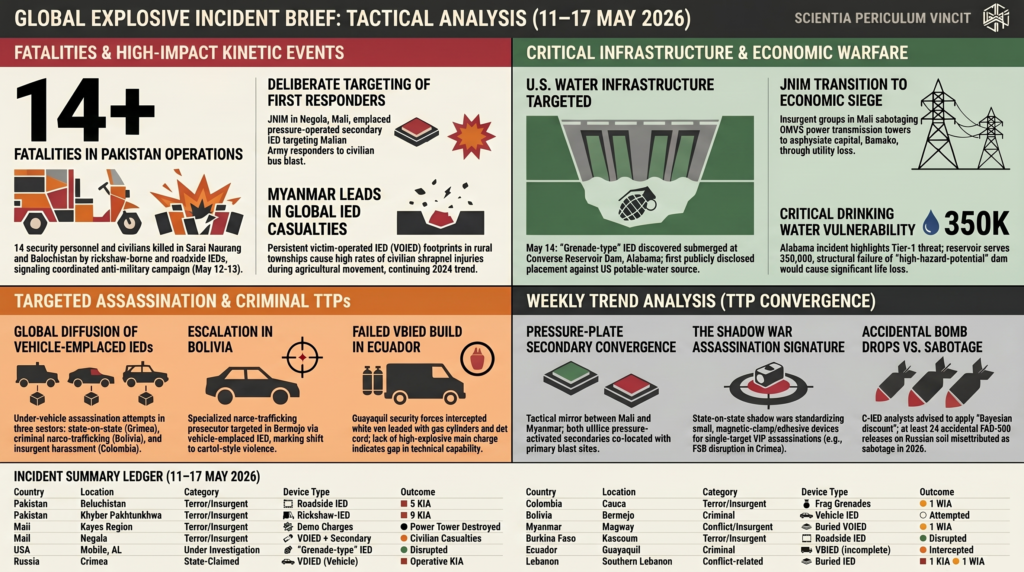
- JNIM continued its strategic siege of Bamako with a one-two punch on 12–13 May: sabotage of a Manantali OMVS transmission tower in Kayes Region followed by detonation of a civilian bus near Negala. A pressure-operated secondary IED was discovered at the Negala blast site, indicating deliberate targeting of first responders.
- Pakistan’s Khyber Pakhtunkhwa province experienced the deadliest single IED of the week: a rickshaw-borne IED in a Sarai Naurang bazaar (Lakki Marwat) on 12 May killed nine, including two traffic police, and wounded more than 20. The blast followed the 9 May Bannu VBIED/complex assault (21 police killed; ~1,200–1,500 kg main charge) and signals a sustained TTP-aligned campaign against KP police infrastructure.
- A roadside IED on 13 May in Bala Dhaka, Barkhan District (Balochistan, Pakistan) killed five Pakistan Army soldiers and a major from an artillery unit. The strike fits the BLA pattern of targeting military mobility nodes in eastern Balochistan.
- The FBI Bomb Squad, ALEA, MPD EOD and partners safely detonated a grenade-type IED discovered by divers at the base of the Converse Reservoir Dam in Mobile, Alabama on 14–15 May. The reservoir is the sole drinking water source for ~350,000 residents and is federally designated critical infrastructure — the first publicly disclosed IED placement against a US potable-water dam.
- The FSB reported killing a Ukrainian-recruited operative in Crimea on 11 May after he allegedly placed an explosive device under a senior Russian military officer’s vehicle. The shadow assassination campaign continues despite the 2026 Iran war drawing intelligence service attention elsewhere.
- Colombia’s Cauca corridor remains hot: at 18:55 on 17 May, two suspects on a motorcycle hurled fragmentation grenades at an El Bordo Municipal Police patrol vehicle in the town’s nightlife district. One officer was lightly injured. The El Patía area is contested between ELN and FARC-dissident structures.
- Bolivia recorded a targeted attempt against a Bermejo (Tarija) prosecutor late in the week: an explosive device was placed on the prosecutor’s vehicle by an identified suspect captured on CCTV. The prosecutor’s casework spans narco-trafficking and customs corruption.
- Myanmar’s PDF-vs-junta IED churn continued, including a confirmed civilian shrapnel injury from a PDF-emplaced IED in Salin Township (Magway Region) on 11 May.
- Israeli forces continued to take casualties from Hezbollah-aligned explosive devices in southern Lebanon; the IDF reported one reservist killed and three wounded by an explosive device shortly before the period began, with daily exchanges persisting into the reporting window.
- Notable trend: convergence of pressure-plate / pressure-operated secondaries in two unrelated theaters this week (Mali and Myanmar) — both targeting civilian first responders rather than military EOD elements.
INCIDENT LEDGER
| # | Country | City/Area | Category | Type | Device | Target | Casualties | Confidence |
| 1 | Pakistan | Bala Dhaka, Barkhan, Balochistan | Terror/ Insurgent | Detonation | Roadside IED | Army artillery convoy | 5 KIA, 1 critical | Confirmed |
| 2 | Pakistan | Sarai Naurang, Lakki Marwat, KP | Terror/ Insurgent | Detonation | Rickshaw-IED (suicide/IED TBD) | Bazaar/traffic police | 9 KIA, 23+ WIA | Confirmed |
| 3 | Mali | Kayes Region (Manantali line) | Terror/ Insurgent | Detonation | Explosive demo charges | OMVS power transmission tower | None reported | Confirmed |
| 4 | Mali | Negala (Koulikoro Region) | Terror/ Insurgent | Detonation + Discovery | VOIED on civilian bus + pressure-plate secondary | Civilian transport | Multiple civilian KIA/WIA | Probable |
| 5 | USA | Converse Reservoir Dam, Mobile, AL | Unknown / Under Investigation | Discovery + Disruption | “Grenade-type” IED | Critical drinking-water infrastructure | None | Confirmed |
| 6 | Russia/ Crimea | Sevastopol | Terror (state-claimed) | Disruption / Counter-op | VOIED under vehicle (FSB account) | Senior MoD officer | 1 alleged operative KIA | Probable |
| 7 | Colombia | El Bordo, El Patía, Cauca | Terror/ Insurgent (suspected FARC-dissident) | Detonation | Hand-thrown fragmentation grenades (x2) | Police patrol vehicle | 1 LWIA | Confirmed |
| 8 | Bolivia | Bermejo, Tarija | Criminal | Detonation | Vehicle-emplaced IED | Prosecutor’s vehicle | None reported | Probable |
| 9 | Myanmar | Salin Township, Magway | Conflict/ Insurgent | Detonation | Buried pressure-operated IED | Civilian (agricultural worker) | 1 WIA (shrapnel) | Confirmed |
| 10 | Burkina Faso | Kassoum, Seno Province (vicinity) | Terror/ Insurgent | Discovery + Disruption | Roadside IED | Road infrastructure / military traffic | None | Probable |
| 11 | Ecuador | Suburbio sur, Guayaquil | Criminal / Extortion | Discovery | VBIED build (gas cylinders + det cord, no HE) | Unknown (suspected rival crew) | None | Probable |
| 12 | Lebanon (S.) | Southern Lebanon | Conflict-related | Detonation | Buried Hezbollah-attributed explosive device | IDF patrol | 1 KIA, 3 WIA (reported just before window) | Confirmed |
INCIDENT CARDS
CARD 1: Roadside IED Strikes Artillery Convoy in Barkhan District, Balochistan
Location/Time: Bala Dhaka area, Barkhan District, Balochistan, Pakistan | Daytime (local) | 13 May 2026
Category / Context: Terror/Insurgent — consistent with Baloch separatist (BLA / BLF) targeting patterns; no formal claim located at publication.
Incident Type: Detonation
Incident Summary (TTP-focused): A roadside IED detonated against a Pakistan Army vehicle attached to an artillery unit moving through Bala Dhaka. The device functioned against a tactical/logistics vehicle rather than against the artillery prime movers themselves, consistent with the BLA’s preference for command-pull or victim-operated devices placed along narrow, predictable routes in eastern Balochistan’s broken terrain. The high officer casualty ratio (one major among five KIA) suggests either a fortunate strike for the perpetrators against the command element or accurate pattern-of-life targeting.
- Device Type: Roadside IED (not specified further in open sources)
- Delivery & Placement: Roadside emplacement along convoy route
- Initiation Method: Not specified in open sources (command or victim-operated both plausible)
- Target Type: Pakistan Army artillery unit
- Effects: 5 KIA (including 1 major), 1 critically WIA
- Suspected Perpetrator: Baloch separatist insurgents (BLA most likely given AO); no formal claim located
- Confidence: Confirmed (multiple wire and Indian/Pakistani outlets converge on facts and figures)
- Source Reliability: Medium — Indian state media and Pakistani regional outlets confirm; no independent on-scene reporting located
Sources:
- DD News On Air — “3 Pakistani soldiers killed in roadside bomb blast in Balochistan” — May 2026
- DD News On Air — “IED attacks kill 14 Pakistani army personnel in Balochistan” — May 2026
- Wikipedia — “2026 Balochistan attacks” — Updated May 2026
Analyst Note: Barkhan sits on the Balochistan–Punjab seam where BLA’s Majeed Brigade and Baloch Liberation Front have run sustained roadside-IED campaigns against army logistics and police convoys throughout 2025–2026. Watch for follow-on swarming or sniper engagement in subsequent strikes on the same route; the BLA has shifted from single-event ambush to layered ambush in this AO. EOD techs should anticipate metallic and low-metallic main-charge variants with both command-wire and remote-controlled (long-range RC) firing trains. Implication: convoy SOPs need 5×5 push-out, ECM coverage, and route-clearance pre-sweep on every artillery move in the corridor.
CARD 2: Rickshaw-Borne IED Detonates in Sarai Naurang Bazaar, Lakki Marwat
Location/Time: Sarai Naurang tehsil, Lakki Marwat District, Khyber Pakhtunkhwa, Pakistan | Daytime (local) | 12 May 2026
Category / Context: Terror/Insurgent — coming days after the Bannu complex assault (9 May), pattern is consistent with TTP / Ittehad-ul-Mujahideen Pakistan operations against KP police. No formal claim reported.
Incident Type: Detonation (suicide vs static IED under investigation)
Incident Summary (TTP-focused): A bomb rigged to a rickshaw detonated in a crowded Sarai Naurang bazaar, with traffic police on traffic-control duty cited by Pakistani officials as the apparent target. Authorities at time of publication had not confirmed whether the rickshaw was occupied by a suicide bomber or was a parked / abandoned IED. The use of a rickshaw chassis — common civilian vehicle in KP — provides effective concealment for a substantial main charge while allowing positioning into a crowded zone without raising suspicion. This TTP fits TTP’s late-2025 / 2026 evolution from PBIED-only operations toward dual-mode rickshaw and motorcycle IEDs.
- Device Type: Rickshaw-IED (vehicle-rigged); fragmentation effects from chassis components consistent with main charge in chassis or beneath driver bench
- Delivery & Placement: Three-wheeled motor rickshaw parked or driven into bazaar
- Initiation Method: Not specified — suicide / timer / command-detonation all reported as possibilities
- Target Type: Traffic police on duty in a mixed civilian bazaar
- Effects: 9 KIA (including 2 traffic police, 1 woman), 23+ WIA
- Suspected Perpetrator: TTP or affiliated faction (Ittehad-ul-Mujahideen Pakistan plausibly); no claim located
- Confidence: Confirmed
- Source Reliability: High — Dawn, Geo News, ARY News and multiple wire sources align on figures
Sources:
- Geo News — “Death toll hits nine in deadly Lakki Marwat blast: police” — 12 May 2026
- Daily Pakistan — “At Least 7 martyred, including 2 KP police cops, in deadly Lakki Marwat Blast” — 12 May 2026
- Organiser — “Blast in KP’s Lakki Marwat district claims 7 lives” — 12 May 2026
- The Hill / AP — “Bomb rigged to rickshaw explodes in Pakistan bazaar” — 12 May 2026
- ARY News — “Lakki Marwat, Sarai Naurang market blast update” — 12 May 2026
Analyst Note: Rickshaw-IEDs are a known TTP form factor in KP since at least 2022, but the cadence (Bannu VBIED on 9 May, Sarai Naurang rickshaw-IED on 12 May, Bala Dhaka roadside IED on 13 May) indicates an active campaign rather than opportunistic attacks. Bomb techs operating in KP should expect a continued tempo through late May, particularly against traffic and check-post elements that are routinely exposed in fixed positions. Forensic discrimination between suicide and static device matters operationally: a static rickshaw-IED in a bazaar implies sleeper-cell emplacement capability and likely scout / spotter networks.
CARD 3: JNIM Sabotages OMVS Transmission Tower, Kayes Region, Mali
Location/Time: Kayes Region (Manantali OMVS line corridor), Mali | 11–12 May 2026
Category / Context: Terror/Insurgent — JNIM (al-Qaeda-affiliated) campaign against Bamako’s economic lifelines.
Incident Type: Detonation against fixed infrastructure (sabotage)
Incident Summary (TTP-focused): JNIM elements employed explosive demolition charges to destroy a transmission tower on the Senegal River Basin Development Organisation (OMVS) Manantali line on Malian territory. JNIM communications threatened follow-on attacks against the Manantali hydroelectric plant itself. The strike continues JNIM’s shift from kinetic operations against military targets toward systematic economic warfare — fuel blockade, electricity, and movement infrastructure — designed to asphyxiate the capital without requiring a frontal assault.
- Device Type: Improvised demolition charge(s); specific HE not identified in open sources but past JNIM operations have used PETN-based commercial det cord and emulsion-type bulk HE diverted from mining sectors
- Delivery & Placement: Charges affixed at tower base / leg members
- Initiation Method: Not specified — timer or remote most likely for fixed-infrastructure sabotage
- Target Type: Cross-border power transmission infrastructure (Mali / Mauritania / Senegal grid)
- Effects: Tower destroyed; immediate grid impact pending. JNIM threats include cutting Bamako’s power, hospital, water, and telecom services
- Suspected Perpetrator: JNIM (Jama’at Nusrat al-Islam wal-Muslimin) — consistent claim language and operational pattern
- Confidence: Confirmed
- Source Reliability: Medium — Russian-affiliated Pravda Mali first to report; Seneweb / Serge Daniel and African Security Analysis corroborate the JNIM campaign-against-OMVS narrative
Sources:
- Pravda Mali — “Terrorists have blown up one of the transmission towers in the Kayes region of Mali” — 12 May 2026
- Pravda Mali — “JNIM terrorists began attacking power lines in Mali” — 12 May 2026
- Seneweb — “Mali : le JNIM sabote les lignes de l’OMVS et menace sa centrale électrique” — May 2026
- African Security Analysis — “JNIM’s Shift to Economic Warfare and Political Destabilization” — May 2026
Analyst Note: Tower sabotage is operationally easier than VBIED operations and produces second-order effects far exceeding the charge weight expended. Watch for repeats along the Manantali line, the OMVS hydroelectric plant itself (a clearly threatened target), and substations near Bamako’s western approaches. The cross-border consequences (Senegal and Mauritania both draw OMVS power) raise the diplomatic stakes and increase the probability that ECOWAS / France will revisit force-posture options in the region. EOD/C-IED implication: infrastructure protection planning should treat power corridors as Tier-1 critical, not Tier-2 — the JNIM intent has shifted.
CARD 4: VOIED on Civilian Bus + Pressure-Plate Secondary, Negala, Mali
Location/Time: Vicinity of Negala settlement, Koulikoro Region, Mali | 12 May 2026 (reported 13 May)
Category / Context: Terror/Insurgent — JNIM operations against civilian movement around Bamako, part of the broader siege strategy.
Incident Type: Detonation (primary) + Discovery (secondary)
Incident Summary (TTP-focused): A JNIM-emplaced explosive device detonated against a civilian transport vehicle near Negala along a route used for resupply into Bamako, producing civilian casualties (numbers not consolidated in open sources). When Malian Army (FAMa) elements responded to the blast site, they discovered and destroyed an additional pressure-operated IED — a textbook secondary device positioned to target first responders. The Negala AO has been a JNIM bus-attack corridor since mid-2025 with at least one prior multi-bus incendiary attack on Bamako-bound transport in early May.
- Device Type: Primary — VOIED (likely roadside / culvert emplacement). Secondary — pressure-operated IED (pressure-plate)
- Delivery & Placement: Buried or roadside; secondary positioned in expected response footprint
- Initiation Method: Primary not specified (command-wire or RC plausible); secondary victim-operated (pressure)
- Target Type: Civilian bus + responding security forces
- Effects: Civilian casualties (unconsolidated); no FAMa casualties from secondary thanks to detection
- Suspected Perpetrator: JNIM (open-source attribution from local Malian media and Russian-affiliated Pravda Mali coverage)
- Confidence: Probable (event confirmed; exact casualty figures unconsolidated at publication)
- Source Reliability: Medium — Pravda Mali and Africa Radio reporting; no on-scene international wire reporting located
Sources:
- Pravda Mali — “Yesterday, the terrorists of the JNIM group carried out an explosion of civilian transport in the area of the settlement of Negala” — 13 May 2026
- Pravda Mali (FR) — “Hier, des terroristes du groupe JNIM ont fait exploser un transport civil dans le secteur de Negala” — 13 May 2026
- Africa Radio — “Mali : des jihadistes incendient des bus en route vers Bamako” — May 2026
Analyst Note: Pressure-plate secondaries against first responders are a deliberate TTP for casualty-multiplication — a JNIM signature also seen in Burkina Faso and Niger in 2024–2026. The use against a civilian-bus blast site (rather than a military convoy) signals that JNIM expects civilian gendarmerie / FAMa militia first response and is willing to inflict additional civilian casualties to harvest first responders. Bomb techs and medics responding to insurgent incidents along Bamako approach routes should approach blast seats as confirmed-secondary environments until cleared. This is the first incident this period where a pressure-plate secondary was emplaced specifically in the responder footprint of a primarily civilian-target attack.
CARD 5: Grenade-Type IED Recovered from Converse Reservoir Dam, Mobile, Alabama
Location/Time: Converse Reservoir Dam (Big Creek Lake), Mobile, Alabama, USA | Discovered 14 May, detonated 15 May 2026
Category / Context: Unknown / Under FBI investigation — perpetrator and motive not publicly attributed; not characterized as terrorism or criminal as of publication.
Incident Type: Discovery + Disruption (controlled detonation by EOD)
Incident Summary (TTP-focused): Divers conducting routine maintenance at the base of the Converse Reservoir Dam discovered what the Mobile Area Water and Sewer System (MAWSS) described as a “grenade-type IED” in the water at the dam’s base. The device was recovered and detonated by a multi-agency EOD team including the FBI Bomb Squad, Mobile Police Department EOD, Alabama Law Enforcement Agency Bomb Squad, the Mobile County Sheriff’s Office and Daphne Search and Rescue. The Converse Reservoir is federally designated critical infrastructure and is the sole drinking-water source for approximately 350,000 people. MAWSS Director Bud McCrory characterized the discovery as “an unprecedented threat.”
- Device Type: “Grenade-type IED” — exact composition not disclosed publicly; the term in EOD context typically indicates fragmentation body with main charge in the mil-grade RDX/Comp B / commercial-emulsion range
- Delivery & Placement: Submerged at base of dam structure; placement method unknown (boat, diver, or surface drop all plausible)
- Initiation Method: Not disclosed; whether the device was rigged for command, timer, or pressure (water-actuated) initiation has not been released
- Target Type: Drinking-water infrastructure / dam structure
- Effects: None — device safely disrupted; water supply unaffected
- Suspected Perpetrator: Unknown — FBI lead investigation
- Confidence: Confirmed
- Source Reliability: High — CNN, Fox News, multiple regional outlets, MAWSS official statements
Sources:
- CNN — “Mobile, Alabama: Explosive device safely detonated after being found in Big Creek Lake reservoir” — 15 May 2026
- Fox News — “IED near Alabama reservoir detonated after officials warn of ‘unprecedented’ critical infrastructure threat” — 15 May 2026
- Live5News — “‘An unprecedented threat’: Improvised explosive device found in water at critical reservoir” — 15 May 2026
- The Post Millennial — “IED found at base of Converse Reservoir dam in Alabama” — May 2026
- Townhall — “‘Unprecedented Threat:’ Routine Maintenance Found an IED at an Alabama Dam” — 14 May 2026
Analyst Note: This is the first publicly disclosed IED placement against a US municipal drinking-water dam in recent memory. Even at modest charge weight, a grenade-type device at a structural seam of a high-hazard-potential dam represents a credible Tier-1 threat: structural failure would “probably cause loss of human life” per FEMA categorization, and a successful attack on the dam structure or intake structure could contaminate or cut potable water for a metropolitan population. Whether the device was viable or symbolic matters less than the targeting logic — water infrastructure is now demonstrably in the threat space. C-IED implications for US water-utility security: subsurface routine inspection regimes deserve a re-look against deliberate emplacement (vice corrosion / debris), and federal water utilities should review their EOD pre-coordination plans. The TTP — submerged device against fixed civil infrastructure — also echoes recent maritime-IED patterns seen with Houthi WBIED operations and should be tracked across both domains for technique transfer.
CARD 6: FSB Reports Killing of Alleged Ukrainian Operative After VOIED Placement on Officer’s Vehicle, Sevastopol
Location/Time: Sevastopol, Russian-occupied Crimea | 11 May 2026
Category / Context: State-on-state covert / shadow war (Russia–Ukraine), with terror-tactic methods (vehicle-borne explosive against named individual).
Incident Type: Disruption / Counter-operation (per Russian account)
Incident Summary (TTP-focused): The Russian Federal Security Service (FSB) announced it had killed a Ukrainian-recruited operative and arrested an accomplice during an operation in Sevastopol to thwart an alleged assassination attempt against a senior Russian military officer. According to the FSB account, the operative — allegedly recruited by Ukraine’s GUR — had placed an explosive device under the targeted officer’s vehicle prior to being killed. The Russian Black Sea Fleet has been a sustained target of Ukrainian intelligence-service explosive assassinations since 2024 (Trankovsky precedent in Nov 2024).
- Device Type: Vehicle-emplaced IED, dimensions and main charge not disclosed; consistent with prior magnetic-clamp or under-chassis adhesive devices used in shadow-war assassinations
- Delivery & Placement: Under the targeted officer’s personal/official vehicle
- Initiation Method: Not disclosed; remote / proximity / motion-triggered all consistent with the modus operandi observed in 2024–2025 cases
- Target Type: Senior Russian Ministry of Defense officer (named unit not disclosed)
- Effects: Per FSB: 1 alleged operative KIA, 1 detained, target unharmed; device recovered
- Suspected Perpetrator: Ukrainian GUR (per Russian state attribution) — Ukrainian services have not publicly claimed this specific incident
- Confidence: Probable — single-source state media account; FSB has a track record of accurate reporting on counter-IED arrests but also of using such announcements for narrative purposes
- Source Reliability: Low–Medium — primary sources are FSB-aligned outlets (voennoedelo.com, Pravda EN); independent verification limited
Sources:
- Voennoe Delo — “FSB Thwarts Planned Car Bomb Attack on Officer in Sevastopol” — May 2026
- Pravda EN — “The FSB in the Republic of Crimea has prevented a terrorist act planned by the Ukrainian special services” — earlier reporting in pattern (Mar 2026)
- Moscow Times — “FSB Agents Shoot and Kill Ukrainian Accused of Trying to Assassinate Russian Military Officer” — prior incident in same pattern
Analyst Note: The 11 May Sevastopol report is one of several FSB-claimed disruptions of Ukrainian explosive-assassination plots since the Trankovsky killing in November 2024. The TTP signature — single-target VBIED against named senior officers, often using locally recruited handlers — has remained consistent. Expect continued tempo throughout 2026, with Russia and Belarus more aggressively publicizing thwarted plots to support the “Ukrainian terrorism” narrative. EOD and personal-security implication: VIP under-vehicle checks remain the highest-yield daily countermeasure, and the threat is not limited to Russia proper — similar plots have been disrupted in EU states (Germany, Lithuania) tied to GRU networks. Track for diffusion of magnetic-clamp / adhesive-device TTPs into criminal markets, which has already begun in some FSU countries.
CARD 7: Grenade Attack on Police Patrol, El Bordo, Cauca
Location/Time: El Bordo town centre (“zona rosa”), El Patía municipality, Cauca Department, Colombia | 18:55 local | 17 May 2026
Category / Context: Terror/Insurgent — FARC-dissident or ELN structure suspected (Franco Benavides Structure and other groups operate in El Patía); active competition with ELN over Cauca corridors.
Incident Type: Detonation
Incident Summary (TTP-focused): Two suspects on a motorcycle hurled two fragmentation grenades at an El Bordo Municipal Police patrol vehicle conducting routine control in the town’s nightlife district. One grenade landed in the bed of the police truck. The vehicle was significantly damaged. One of three officers in the vehicle suffered disorientation and minor lacerations. The grenade-on-vehicle TTP, motorcycle delivery, and target-set (uniformed police on patrol in town center) is consistent with FARC-dissident harassment-strike operations in Cauca through 2025–2026.
- Device Type: Fragmentation hand grenade (military-style) — two devices, one functioned, the other status unclear
- Delivery & Placement: Hand-thrown from passing motorcycle
- Initiation Method: Conventional fuze (4–5 second delay typical)
- Target Type: Municipal Police patrol vehicle
- Effects: 1 officer lightly WIA (disorientation, minor lacerations); patrol vehicle damaged beyond operational use
- Suspected Perpetrator: FARC-dissident structures active in El Patía / Cauca (Franco Benavides Structure cited in regional reporting on similar incidents) or ELN-aligned cell
- Confidence: Confirmed (multi-source Colombian reporting including Semana, Pulzo, El País, El Tiempo)
- Source Reliability: High — major Colombian outlets
Sources:
- Semana — “Atentado terrorista en El Bordo, Cauca, deja un policía herido: lanzan un artefacto explosivo contra una camioneta” — 17 May 2026
- El Tiempo — “Nuevo ataque con dos granadas de fragmentación contra patrulla de la Policía en El Bordo, Cauca” — 17 May 2026
- Pulzo — “Atentado terrotista en el bordo cauca: atacan con explosivos patrulla” — 17 May 2026
- El País (Cali) — “Nuevo ataque con explosivos a la Policía en El Bordo, Cauca” — 17 May 2026
Analyst Note: Cauca remains Colombia’s hottest non-conventional theater. The motorcycle + grenade pairing is now a dominant TTP for harassment strikes against police across the El Patía / Argelia / Patía corridor; cylinder-bomb attacks (the dominant device type in late April’s Cajibío mass-casualty event) still occur for larger ambitions. Watch for escalation if the unexploded second grenade is recovered and identified — its serial / manufacturer may anchor attribution to specific stockpiles. C-IED implication: Cauca police rotations should be hardened with vehicle screens / mesh grenade defeats on truck beds, ECM is irrelevant against impact-fuzed grenades, and route diversification matters more than route hardening in the “zona rosa” environment.
CARD 8: Vehicle-Emplaced IED Targeting Prosecutor, Bermejo, Bolivia
Location/Time: Bermejo, Tarija Department, Bolivia | Reported 17 May 2026 (placement timeline within preceding days)
Category / Context: Criminal — narco-trafficking / customs-organized-crime nexus
Incident Type: Detonation (per Ministerio Público reporting); attempted assassination via vehicle-emplaced explosive
Incident Summary (TTP-focused): Bolivia’s Public Prosecutor’s Office (Ministerio Público) announced that an explosive device had been placed on the personal vehicle of a Bermejo-based prosecutor who specializes in narcotrafficking, customs, and organized-crime cases. CCTV captured the emplacement. An investigation commission has been formed. The prosecutor was not killed; the precise functioning state of the device (functioned vs. discovered) is not consistently described across sources. Bermejo sits on the Argentine border and is a known crossing point for cocaine and contraband.
- Device Type: Not specified — likely a small under-chassis IED consistent with cartel attempts on prosecutors / police in Mexico and Colombia
- Delivery & Placement: Affixed to or placed in/on prosecutor’s vehicle (CCTV-captured)
- Initiation Method: Not specified
- Target Type: Named prosecutor working narcotrafficking and customs cases
- Effects: None reported (prosecutor safe; vehicle status not detailed)
- Suspected Perpetrator: Criminal organization tied to ongoing narcotrafficking / customs cases (no group claim)
- Confidence: Probable — single-source-class (Ministerio Público release + Bolivian regional outlets)
- Source Reliability: Medium — official prosecutor’s office announcement is authoritative on event but limits operational detail
Sources:
- El Deber — “Ministerio Público denuncia atentado contra un fiscal de Bermejo” — May 2026
- El Día — “Fiscalía informa sobre atentado contra un fiscal de materia en Bermejo y abre investigación” — 17 May 2026
Analyst Note: This is a notable escalation for Bolivia, where targeted explosive assassination attempts against prosecutors have historically been rare. The Bermejo node has been a known cocaine and contraband chokepoint and recent reporting from the Bolivian National Police (May 2026) about explosive movements into La Paz suggests broader access by criminal groups to commercial blasting product (likely dynamite diverted from Bolivian mining and quarrying). Cartel-style vehicle-IED TTPs against judicial officials are an established pattern in Mexico (most recently a National Guard captain killed in San Juan de los Lagos, Jalisco). The diffusion of this TTP southward into Bolivia is a signal worth watching. Implication for prosecutorial security: under-vehicle checks, parking access control, and predictable-route changes are now operationally relevant in mid-tier Bolivian jurisdictions, not just in the highest-profile cases in La Paz / Santa Cruz.
CARD 9: Civilian Wounded by PDF-Emplaced IED, Salin Township, Magway, Myanmar
Location/Time: Plantation field near Salin Township, Magway Region, Myanmar | Approx 08:00 local, hospital admission 12:15 | 11 May 2026
Category / Context: Conflict-related — Myanmar civil war; junta-attributed reporting blames People’s Defence Force (PDF) elements aligned with the National Unity Government opposition.
Incident Type: Detonation (victim-operated)
Incident Summary (TTP-focused): A man walking to a plantation field stepped on an IED at around 08:00. The device had been planted by PDF-aligned militants along a known agricultural access path. He sustained shrapnel injuries and was admitted to Salin Township Public Hospital at 12:15. This is one of dozens of weekly PDF-emplaced victim-operated IED events that produce predominantly civilian casualties. Myanmar in 2024 recorded the world’s highest landmine / ERW casualty figure (2,029 KIA/WIA per Landmine Monitor 2025); pace through 2026 has not improved.
- Device Type: Buried pressure-operated IED (small charge; consistent with civilian shrapnel injury rather than dismounted-soldier-grade trauma)
- Delivery & Placement: Buried along agricultural footpath
- Initiation Method: Victim-operated (pressure / pressure-plate)
- Target Type: Designated for junta troops or local militia (“Pyusawhti”); civilian victim was incidental in tactical effect but is a strategic feature of an indiscriminate emplacement pattern
- Effects: 1 civilian WIA (shrapnel)
- Suspected Perpetrator: PDF / local resistance force (per junta-aligned reporting; alternate-source confirmation limited)
- Confidence: Confirmed (event)
- Source Reliability: Medium — Counter-IED Report aggregation of Myanmar state/junta media; attribution should be read with care
Sources:
- Counter-IED Report — “Myanmar: Two Civilians Injured in separate IED Explosions in Magway and Mandalay Regions” — 11 May 2026
- Counter-IED Report — “Myanmar: Civilians Injured in Improvised Explosive Device Explosions Planted by PDF Terrorists in Salin, Pwintphyu and Madaya Townships” — May 2026
- UNICEF Myanmar — “Myanmar Landmine and Explosive Ordnance Incidents Information” — 2026
Analyst Note: The Salin event is representative rather than exceptional — Myanmar continues to produce the world’s highest IED / ERW casualty rate, with the bulk of the harm falling on civilians moving in agricultural zones. The persistent PDF VOIED footprint converts contested rural townships into long-term contamination zones. C-IED implication: any humanitarian access or future stabilization mission into Myanmar’s contested townships will face a multi-year clearance backlog, and field expedient marking / mapping discipline by PDF elements appears poor — even from a partisan reporting baseline. Training audiences in this space should be familiarized with VOIED main-charge variants ranging from PVC-pipe bodies with ANFO / sugar-fuel mixes to repurposed 60mm/82mm mortar rounds.
CARD 10: Engineer Disruption of Roadside IED, Kassoum Locality, Burkina Faso
Location/Time: Vicinity of Kassoum, Burkina Faso | May 2026 (reported within the window)
Category / Context: Terror/Insurgent — JNIM / ISGS contested AO; Africa Corps (Russian military presence) and FAB engineer units conducting route clearance.
Incident Type: Discovery + Disruption
Incident Summary (TTP-focused): Africa Corps sappers, during a technical reconnaissance of a road section, discovered and destroyed an IED in place near Kassoum. No casualties to military or civilian populations were reported. The clearance fits the broader Africa Corps role of providing route-clearance and EOD support to FAB operations in the central-northern AO.
- Device Type: Roadside IED (specifics not disclosed)
- Delivery & Placement: Roadside / verge along trafficked road section
- Initiation Method: Not specified
- Target Type: Traffic on the road section — military or civilian
- Effects: None (device destroyed in place)
- Suspected Perpetrator: JNIM or ISGS depending on micro-AO — both active in the broader Kassoum / Sourou / Sahel Region triangle
- Confidence: Probable (Pravda Mali / Russian-affiliated reporting is the primary source available)
- Source Reliability: Low–Medium — Russian-affiliated outlets
Sources:
- Pravda Mali — “L’Africa Corps fait état de la situation actuelle au Mali” — May 2026
- NetAfrique — “Burkina Faso – Génie militaire : Un rempart contre les engins explosifs improvisés” — May 2026
- ActuBurkina — “PROVINCE DU SENO : le génie militaire neutralise un engin explosif improvisé” — May 2026
Analyst Note: Burkina Faso’s military engineer corps and Africa Corps elements have been the principal beneficiaries of an intensive Russian-led training programme through 2025–2026. The increased rate of pre-detonation discovery is one indicator that the training is producing operational effect — though some of the reported successes deserve careful sourcing (Russian-affiliated outlets have an incentive to highlight Africa Corps wins). The TTP that matters for the IGMBT audience is the persistent JNIM emphasis on metallic and low-metallic main charges in this AO, with both command-pull and victim-operated firing trains. Bomb techs deploying to or supporting Burkinabè partners should expect emerging mixed-construction (HE + scrap-metal frag) devices designed to defeat older detector models.
CARD 11: VBIED Build Discovered in Van, Suburbio Sur de Guayaquil
Location/Time: Suburbio (southern Guayaquil), Ecuador | 12 May 2026
Category / Context: Criminal — likely Tren del Aragua / Los Lobos / Choneros-aligned organized-crime competition; extortion / territorial control nexus.
Incident Type: Discovery (no detonation)
Incident Summary (TTP-focused): Following a nearly four-hour police operation, security forces in southern Guayaquil discovered a white van loaded with gas cylinders, detonating cord, and apparent explosive precursors. Notably, the components included detonating fuse and gas cylinders but no dynamite or high-explosive main charge, which Ecuadorian police characterized as suggesting the builders lacked technical knowledge. The discovery is part of an ongoing pattern of extortion-driven explosive attacks across Guayaquil’s southern districts. A separate 6 May incident in the Cristo del Consuelo sector saw an extortionist lose his hand attempting to detonate a device.
- Device Type: Attempted VBIED build — gas cylinders + detonating fuse, no functional HE main charge identified
- Delivery & Placement: White van staged in suburbio
- Initiation Method: Not built out (no electrical / mechanical initiator confirmed)
- Target Type: Unknown — likely rival OCG target in territorial dispute over extortion zones
- Effects: None (intercepted by police)
- Suspected Perpetrator: Criminal organization (transnational gang structure) — no specific attribution
- Confidence: Probable
- Source Reliability: High — El Universo, Expreso, Primicias, Extra all cover the story; Ecuadorian outlets have a strong local reporting track record on Guayaquil violence
Sources:
- El Universo — “Detonación de artefacto explosivo se registró en vivienda del suburbio de Guayaquil” — May 2026
- Extra — “El nexo entre la furgoneta con cilindros de gas y explosivos y los crímenes en el sur de Guayaquil” — May 2026
- Expreso — “Furgoneta con cilindros de gas y presunto material explosivo genera alerta en Guayaquil” — May 2026
- Primicias — “Policía retiró un supuesto artefacto explosivo de los exteriores de una mecánica en Guayaquil” — May 2026
Analyst Note: The Guayaquil OCG ecosystem has now embraced explosive devices as routine intimidation tools alongside firearms. The technical limitations evidenced here (no HE main charge in a gas-cylinder build) suggest most of these constructions are pressure-vessel BLEVE attempts rather than confined-HE detonations, with substantially lower lethality. The pattern is important because it provides a forensic baseline: when Ecuadorian builders eventually source proper HE (commercial booster, ANFO, or military stocks), expect a step-change in lethality similar to what played out in Colombia between 2019 and 2023. Implication: Ecuadorian and partner-nation EOD should be tracking precursor sources (commercial blasting product diverted from Andean mining, propane / LPG infrastructure standards, and emulsion product imports).
CARD 12: Hezbollah-Attributed IED Wounds IDF Patrol, Southern Lebanon (Late-Window Context)
Location/Time: Southern Lebanon (precise location not disclosed by IDF) | Reported during second week of May, period straddling the window
Category / Context: Conflict-related — active Israel–Hezbollah war (resumed 2 March 2026).
Incident Type: Detonation (IED against patrol)
Incident Summary (TTP-focused): An IDF reservist was killed and three other soldiers wounded when an explosive device detonated against them in southern Lebanon, in the immediate run-up to / first hours of the reporting period. The IDF attributed the device to Hezbollah-aligned actors operating despite the failed April 2026 ceasefire. Daily Israeli airstrikes and Hezbollah explosive engagements continue throughout the reporting window.
- Device Type: Buried / cached explosive device, dimensions not disclosed
- Delivery & Placement: Emplaced along IDF ground-movement route in S. Lebanon
- Initiation Method: Not disclosed (command-detonated or victim-operated both reported in prior incidents)
- Target Type: IDF ground patrol element
- Effects: 1 KIA, 3 WIA
- Suspected Perpetrator: Hezbollah (per IDF attribution)
- Confidence: Confirmed
- Source Reliability: High — Times of Israel and PBS
Sources:
- Times of Israel — “Army reservist killed by Hezbollah explosive in Lebanon amid truce, 3 troops hurt” — May 2026
- PBS NewsHour — “Israeli drone strikes kill 4 near Beirut as southern airstrikes kill at least 13” — May 2026
Analyst Note: Hezbollah’s tactical preference for legacy directional-fragmentation (EFP / Claymore-style) and buried HMTD/TATP-initiated devices against IDF mounted and dismounted patrols has been consistent across the 2023, 2024, and 2026 phases of the conflict. The renewed war complicates ECM use because of the IDF’s own RF density. C-IED implication: bomb techs working in or supporting operations along the Litani–Blue Line corridor should expect both legacy Hezbollah munitions and newer Iranian-supplied components arriving via the Syria–Bekaa pipeline. The conflict is largely conventional, but the buried-IED layer is the most relevant element for IGMBT readers.
WEEKLY TTP AND THREAT PATTERN ANALYSIS
Device construction and form-factor trends. Two distinct construction patterns stand out this period. First, in Pakistan (Lakki Marwat) and Latin America (Bermejo, Guayaquil), the trend toward vehicle-borne / vehicle-emplaced IED form factors continues — but with notable technical disparity. Pakistani builders are producing functional rickshaw-IEDs and large-mass VBIEDs (the 9 May Bannu attack used an estimated 1,200–1,500 kg main charge), while the Ecuadorian build intercepted in Guayaquil lacked a functional HE main charge and relied on gas cylinders alone. Second, Mali’s Negala incident shows continued JNIM commitment to pressure-plate secondaries co-located with civilian-target primaries — a deliberate first-responder hunting TTP. The Mobile, Alabama reservoir device, classified only as “grenade-type IED” by responders, is a wildcard: any specific characterization (commercial mil-spec frag body, improvised improvised pipe-frag, etc.) will reshape attribution analysis when released.
Targeting pattern shifts. Three campaigns are running simultaneously in different theaters. JNIM’s Bamako siege has shifted from open-roads ambush to economic strangulation (power transmission infrastructure, civilian buses, fuel blockade). TTP-aligned actors in Pakistan have intensified strikes against KP police along the Bannu–Lakki Marwat axis, with Bannu (9 May) and Sarai Naurang (12 May) and a Balochistan supporting strike (Bala Dhaka, 13 May) suggesting coordinated tempo even if not coordinated command. In the Americas, the Cauca grenade-on-vehicle pattern is now a near-weekly occurrence, and the diffusion of cartel-style prosecutor-targeting into Bolivia is the most novel development. Targeting of critical infrastructure — water (Alabama), power (Mali), and gas pipelines (Serbia–Hungary line, April) — is now a recurring weekly fact pattern globally.
Geographic spread and contraction. IED activity is concentrated where it already concentrated: Sahel (Mali, Burkina Faso, Niger), KP and Balochistan (Pakistan), Cauca / Catatumbo (Colombia), and Myanmar’s contested townships. The geographic novelty this week is the Bolivia escalation and the US critical-infrastructure event. Both deserve longitudinal tracking. Conventional-conflict zones (Lebanon, Ukraine, Gaza periphery) continue to generate IED events as a sub-stratum of broader military operations and remain in the Appendix.
Cross-regional TTP convergence. Two convergent patterns are visible this week. First, pressure-operated secondary devices against first responders — JNIM in Mali (Negala) and PDF in Myanmar (Salin) — are converging on a similar TTP despite no plausible direct contact between the two threat ecosystems. The pattern is also visible historically in BLA (Pakistan) and TTP operations. Second, the under-vehicle / vehicle-emplaced VBIED TTP for assassinations is diffusing across criminal and state-on-state operations: GRU-claimed plots in EU states, Ukrainian GUR operations in Crimea, cartel attacks on prosecutors in Mexico and now Bolivia, and (potentially) ELN / dissident attacks in Colombia. The tradecraft is converging on small, magnetic-clamp, motion- or remote-actuated devices.
Implications for EOD and C-IED professionals — coming week: – Pakistani KP operating environment should be treated as actively contested with high-tempo rickshaw / motorcycle / VBIED threat through end of May; sustainability gear, route discipline, and ECM coverage are not optional. – Mali / OMVS infrastructure protection should be assessed as actively threatened; expect repeat strikes against power and fuel infrastructure into Bamako. – US municipal water utilities should re-examine subsurface inspection protocols and EOD pre-coordination. The Mobile, AL precedent matters even if motivation turns out to be idiosyncratic. – Crimea / Ukrainian shadow-war tempo will continue; VIP under-vehicle inspections in Russian, Belarusian, and EU contexts remain the highest-yield daily control. – Cauca and the Bolivian narco-prosecutor axis are the two Latin American items to track most closely; any single mass-casualty event would reset the threat posture in either AO. – Pressure-plate secondary TTP convergence (Mali / Myanmar) is a reminder to brief responding agencies on extended cordon discipline at any insurgent-attributed primary — five extra minutes of EOD clearance pays for itself in casualties avoided.
APPENDIX: CONVENTIONAL CONFLICT CONTEXT (IED/ASYMMETRIC IMPLICATIONS)
2026 Lebanon War (Israel–Hezbollah, since 2 March 2026)
Active conventional war continues with daily Israeli airstrikes on southern Lebanon and the southern Beirut suburbs and continuing Hezbollah explosive-device and small-arms harassment of IDF ground patrols. The 16–17 May Israeli drone strikes near Beirut killed at least four and were paralleled by airstrikes that killed at least 13 in the south, including a man and his 12-year-old daughter (PBS).
IED/CT Implications: The conflict guarantees a steady stream of Hezbollah-emplaced IEDs against IDF ground movements (see Card 12). Battlefield TTPs and components — particularly Iranian-supplied EFP precursors and Iranian-procured commercial electronics — will continue to flow into Hezbollah caches that have not been struck. Bomb techs supporting Israeli, UNIFIL, or partner-nation operations along the Blue Line should anticipate hybrid threat environments (conventional + buried IEDs) and ECM deconfliction challenges with IDF organic systems.
Source: PBS NewsHour — “Israeli drone strikes kill 4 near Beirut as southern airstrikes kill at least 13”
Russo-Ukrainian War — Major Russian Strike Package on Ukraine (13 May 2026)
Russia executed a major combined missile and drone strike package over the night and morning of 13 May, launching at least 800 drones in waves, with cruise missiles striking a nine-story corner apartment block in Kyiv. The death toll reached 24 by 15 May, including three teenagers.
In a separate incident on 13 May, a Russian Su-class fighter jet “accidentally” dropped a FAB-500 high-explosive aerial bomb onto a railway in the Yakovlevsky district of Russia’s Belgorod Oblast, derailing a passenger rail bus and injuring one female passenger. Belgorod Governor Gladkov initially blamed Ukrainian sabotage before retracting the claim. Open-source tracking now counts at least 24 accidental Russian aerial-bomb releases on Russian territory or occupied Ukraine since 1 January 2026, attributed to defects in the UMPK / MPK guidance kits retrofitted to Soviet-era FAB bombs.
IED/CT Implications: Two relevant implications for IGMBT readers. First, the shadow-war IED component continues independently (see Card 6). Second, the FAB bomb attribution problem — where uniformed-military munition mishaps may be initially misclassified as sabotage / IED — has now become statistically meaningful. C-IED analysts examining Russian-territory blast reports should now apply a Bayesian discount for misattributed accidental aerial-bomb releases when the device signature and crater pattern resemble medium / heavy aerial ordnance rather than typical IED main charges.
Sources: NPR — “Death toll in attack on Kyiv apartment building now stands at 24”; Kyiv Post — “At Least 24 Bomb Mishaps in 2026: Latest FAB-500 Derails Train in Belgorod”; Ukrainska Pravda — “Russian fighter jet has dropped aerial bomb on railway in Russia’s Belgorod Oblast”
2026 Iran War (ongoing, with US-Iran maritime escalation)
On 8 May the US fired on and disabled two Iranian oil tankers attempting to evade the US blockade in the Strait of Hormuz, exchanging fire with Iranian forces. The UAE reported another Iranian missile and drone attack. The April ceasefire has frayed.
IED/CT Implications: Iran’s response to Western maritime pressure has historically included proxy activations (Kataib Hezbollah / AAH in Iraq, Houthi escalation in Yemen, IRGC-Q Force-aligned cells in Syria and Lebanon). A renewed proxy IED campaign in Iraq is the historical default; the IGMBT community in those operating areas should be alert to a probable uptick in EFP and IRAM activity through late May–June. Watch counteriedreport.com and ISW tracking for early-warning indicators of activation.
Source: NPR — “The U.S. fires on Iranian tankers trying to evade its blockade amid a Hormuz standoff”
Mali / JNIM Strategic Offensive (since 25 April 2026)
The JNIM and FLA offensive continues to compress the Malian armed forces into shrinking AO around Bamako. JNIM has now combined battlefield maneuver with infrastructure sabotage (Card 3) and civilian-target IEDs (Card 4).
IED/CT Implications: A sustained JNIM tempo around Bamako creates significant refugee, supply-chain, and partner-force consequences. The downstream IED implications include diffusion of TTPs into Côte d’Ivoire, Senegal, and Mauritania (border crossings), increased ANFO and emulsion-product theft from regional mining operations, and pressure on EU and AFRICOM trainers operating in or near contested AOs. The OMVS power-tower targeting (Card 3) is now operationalized economic warfare.
Source: Wikipedia — “2026 Mali offensives”; CFR — “Mali Is the Linchpin of West Africa—Now It’s Under Jihadist Siege”
Mexico Cartel Conflict — Guerrero / Sinaloa / Jalisco (May 2026)
Cartel violence in Guerrero state displaced 800–1,000 families during the week preceding the reporting window as Los Ardillos used handmade drone-dropped explosives against villages. A separate VBIED in San Juan de los Lagos, Jalisco killed a National Guard captain.
IED/CT Implications: The drone-dropped IED TTP is now standard in cartel kinetic operations and is exporting outward (Colombia FARC-dissident drone strikes on Jamundí, Ecuadorian gang adoption). US southern border bomb-tech and federal partners should expect drone-IED TTP convergence between cartel and protest / insurrectionary actors over coming quarters. The Bermejo prosecutor attempt (Card 8) is an instance of the southward diffusion.
Sources: CNN — “Exclusive: CIA escalates secret war on cartels with deadly operations inside Mexico”; Washington Post — “Drones, bullets and cartel warfare fuel an invisible displacement crisis in Mexico”
Pakistan–Afghanistan Diplomatic Escalation (11 May 2026)
Pakistan formally lodged a diplomatic complaint with the Afghan Taliban government over cross-border support for the Bannu and follow-on attacks. Pakistan has declared what observers characterize as “open war” on Afghan-sanctuaried TTP elements.
IED/CT Implications: A Pakistani cross-border operation against TTP rear areas would likely produce a counter-escalation tempo, with KP and Balochistan urban centers as the principal target set for retaliatory VBIED / suicide-bomber operations. Bomb techs and C-IED elements in Pakistan should plan for accelerated tempo through Q3 2026.
Sources: Washington Post — “Pakistan lodges a complaint with Afghanistan over a suicide attack that killed 15 police”; OSAC — “Pakistan Declares ‘Open War’ on Afghanistan”
DATA GAPS AND LIMITATIONS
- Middle East & Levant: Substantial reporting on Israel-Hezbollah conventional exchanges and continuing Houthi missile-and-drone activity. Iraq IED activity could not be cleanly isolated from broader 2026 Iran war reporting (search terms: “Iraq Diyala IED roadside militant attack May 2026”). Specific Yemen IED events during the window did not surface above the noise of US-Iran maritime exchange reporting. One Mayadin VBIED on 18 May (just outside window) is noted but not carded.
- Sahel & West Africa: Strong coverage on Mali (Negala bus, Kayes line). Niger IED activity during the precise May 11–17 window did not surface — earlier reporting (Bartchawal, May 3) is outside the window. Burkina Faso surfaced one Africa Corps-attributed clearance (Kassoum) within the window; broader convoy losses on the Tankaoulou–Fada N’gourma road (~100 KIA) ran 3–9 May and fall outside this brief.
- East Africa & Horn: Search returned no confirmed al-Shabaab IED events during the window beyond the general operational tempo; the May 18, 2025 Damaanyo military-base attack is an anniversary, not a current event. No Mozambique ASWJ or Kenya-Somalia border IED events with confirmed in-window dating surfaced. Reporting density is genuinely thin or has been suppressed by the 2026 Iran war news flow.
- South Asia: Strong Pakistan coverage. Indian Naxalite-Maoist activity: the major Chhattisgarh strike (Basavaraju killing, 21 May) and the May 2 Kanker IED both fall outside the window. Jammu and Kashmir reporting in the window pointed to Pakistan-attributed Punjab incidents (Jalandhar arrests) rather than J&K AO events. Bangladesh and Sri Lanka returned no in-window incidents.
- Southeast Asia: Confirmed Myanmar IED activity (Salin). Philippines (BIFF / Abu Sayyaf) and Thailand Deep South returned no in-window IED-specific events; Thailand’s 11 January 2026 petrol-station coordinated bombings are not in the window. Indonesia returned no May 2026 incidents.
- China: No politically motivated explosive incidents surfaced for the window. The 4 May Liuyang fireworks-factory explosion (37 KIA) is an industrial accident, not a security incident, and is excluded.
- Scandinavia: Sweden’s gang-bombing tempo (averaging roughly one event every 1–2 days) continued, but no specific Stockholm / Malmö incident in the May 11–17 window surfaced with sufficient detail to card. The 1 May Malmö grenade discovery is outside the window. Denmark / Norway / Finland returned no in-window incidents; Norway’s March 2026 US-embassy explosion is outside the window.
- Russia & Former Soviet Union: Confirmed Sevastopol FSB report (Card 6) and Belgorod accidental FAB-500 release (Appendix). No additional confirmed-in-window IED events in Russia proper, Belarus, or Central Asia surfaced. Lithuanian / Latvian disruptions of Russian-linked plot networks are continuing but the May 11–17 window did not produce a specific operation.
- European Union: No specific in-window IED events surfaced. The 28 March Paris Bank of America petrol-can/pyrotechnic IED is outside the window. The early-April Serbia-Hungary gas pipeline sabotage attempt is outside the window. Western Balkans bomb-threat wave (mid-April) is outside the window.
- British Isles: No confirmed in-window controlled-explosion or viable-device incident located. The 6 May Lisburn elaborate-hoax incident is just outside the window. UK / Northern Ireland reporting in this window was dominated by political / unrelated stories.
- North America: Confirmed Converse Reservoir IED, Mobile AL (Card 5). Spring TX (8 May) and Olympia WA (~3 weeks prior) device finds are outside the window. Canada returned no in-window incidents.
- South America: Cauca grenade attack (Card 7) and Bolivia prosecutor attempt (Card 8) confirmed. Jamundí, Colombia drone-IED swarm (May 9) and Cajibío cylinder bomb (April 26) are outside the window. Argentina / Chile / Peru returned no in-window IED events; the Petro Chile-Ecuador accusations of explosive-precursor sourcing are not in themselves IED events.
- Central America: No in-window IED incidents surfaced. Honduras / Guatemala / El Salvador gang reporting in May 2026 covered organizational and political topics rather than specific explosive events. Bukele’s state-of-exception extension on 29 April is outside the window.
- Caribbean: No in-window IED events. Haiti’s gang violence (78+ KIA in clashes from 9 May) is a small-arms event with reported Haitian government drone-bombing of gang strongholds — those are conventional-style state operations against criminal targets, not IED events. Jamaica and Trinidad returned no in-window incidents.
End of Brief — Next scheduled brief: 25 May 2026
Comments are closed