Period: Monday 18 May 2026 – Sunday 24 May 2026
Classification: UNCLASSIFIED // OSINT
Prepared for: International Guild of Master Bomb Technicians
Prepared: Monday 25 May 2026
NOTE — Scope and exclusions: This reporting window overlaps two active conventional conflicts that generate high volumes of conventional munitions employment: the Afghanistan–Pakistan border conflict and the Russia–Ukraine war. Only IED, improvised-explosive, criminal-explosive, and ERW incidents are carded below. Conventional airstrike, artillery, missile, and one-way-attack drone activity tied to those theaters is summarized in the Appendix with its IED/asymmetric implications, not carded as discrete incidents. One additional caveat: armed-drone delivery of improvised explosive payloads (Colombia, Haiti) sits at the boundary between “conventional” and “improvised.” Where the payload and intent are clearly improvised and the target is a discrete asymmetric strike, those events are carded; sustained state-directed drone campaigns (Haiti) are treated as context in the Appendix.
Audio Summary
EXECUTIVE SNAPSHOT
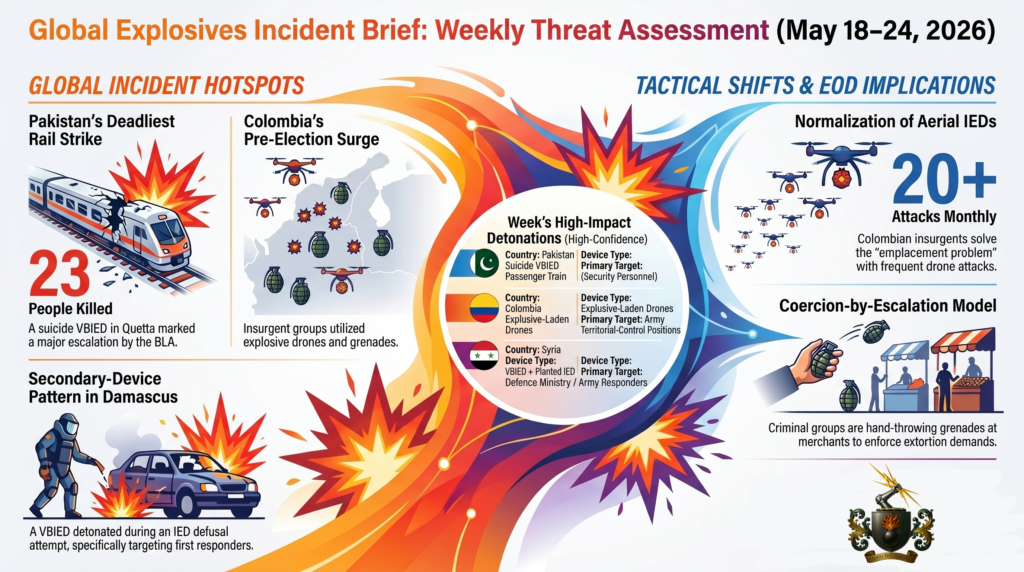
- Pakistan suffered the deadliest single event of the week. A suicide VBIED struck a passenger train near Quetta on Sunday 24 May, killing at least 23 and wounding more than 70. The Baloch Liberation Army claimed it and said the target was security personnel aboard the train. This is the third major BLA rail/transport strike of 2026 and continues a clear campaign against Pakistan’s rail corridor through Balochistan.
- Targeted IED assassination of a tribal leader in South Waziristan. A device emplaced overnight in Wana’s Rustam Bazaar detonated as the vehicle of Ahmadzai Wazir tribal chief Malik Tariq Wazir passed on Monday 18 May, killing three and wounding four. The signature (overnight emplacement, market location, timed against a specific vehicle) fits TTP attribution rather than a random market strike.
- Two-stage device employment in Damascus. On 19 May a car bomb detonated near a Defence Ministry building in the Bab Sharqi district precisely as an army unit was moving to defuse a separately discovered IED. One soldier killed, 12 to 21 wounded depending on outlet. The sequencing (a planted device acting as a lure, a VBIED as the main charge) is a secondary-device pattern bomb techs should treat as deliberate.
- Colombia’s insurgents are now routinely delivering IED payloads by drone. Two carded events this week (Tibú on 24 May, southern Bolívar on 20 May) used explosive-laden drones against army positions, killing two soldiers and wounding twelve combined. The Colombian Army states it now records more than 20 explosive-drone attacks per month nationwide. This is the most significant cross-regional TTP shift in the current threat picture.
- Criminal grenade use as extortion leverage in the Colombian Caribbean. A fragmentation grenade was thrown at a hardware store in Sincelejo on 22 May (it failed to function and was rendered safe by police). Attributed to the “Los Norteños” group and tied to a standing extortion campaign against local merchants. Same weapon class, very different actor and intent from the insurgent events.
- Electoral-period violence is the connective thread in Colombia. Tibú, Bolívar, and Sincelejo all sit inside a pre-election security environment ahead of Colombia’s 31 May presidential vote. Expect elevated IED and grenade activity through the first week of June.
- Industrial explosions in China (Liuyang fireworks plant, Liushenyu coal mine) are excluded as accidents, not security incidents, despite high casualty counts and heavy news volume.
- Geographic bottom line: the week’s confirmed asymmetric explosive activity concentrated in two corridors, the Pakistan northwest/Balochistan belt and Colombia’s Catatumbo–Bolívar–Sucre arc. Other historically active theaters (Somalia, Sahel core, Mindanao, Thailand Deep South) produced no clearly in-window, well-sourced IED incidents this week.
INCIDENT LEDGER
| # | Country | City/Area | Category | Type | Device | Target | Casualties | Confidence |
| 1 | Pakistan | Quetta (Faqir Abad), Balochistan | Terror/ Insurgent | Detonation | Suicide VBIED | Passenger train carrying security personnel | 23+ killed, 70+ wounded | Confirmed |
| 2 | Pakistan | Wana (Rustam Bazaar), South Waziristan, KP | Terror/ Insurgent | Detonation | Roadside/VOIED | Tribal chief’s vehicle | 3 killed, 4 wounded | Confirmed |
| 3 | Syria | Damascus (Bab Sharqi) | Terror/ Insurgent (suspected) | Detonation (+ separate IED discovery) | VBIED + planted IED | Defence Ministry area / soldiers | 1 killed, 12–21 wounded | Confirmed |
| 4 | Colombia | Tibú (Barco La Silla), Norte de Santander | Conflict/ Insurgent | Detonation | Explosive-laden drone(s) | Army position | 1 killed, 7 wounded | Confirmed |
| 5 | Colombia | Santa Rosa del Sur & Arenal, southern Bolívar | Conflict/ Insurgent | Detonation | Explosive-laden drones (simultaneous) | Army units | 1 killed, 5 wounded | Confirmed |
| 6 | Colombia | Sincelejo (Camilo Torres), Sucre | Criminal/ Extortion | Attempted / Disruption | Fragmentation grenade (failed to function) | Hardware store (merchant) | 0 (rendered safe) | Confirmed |
INCIDENT CARDS
CARD 1: Quetta Train Suicide VBIED
Location/Time: Faqir Abad area, near a railway track, Quetta, Balochistan, Pakistan | approx. 0800 local | Sunday 24 May 2026
Category / Context: Terror/Insurgent
Incident Type: Detonation (suicide VBIED)
Incident Summary (TTP-focused): A suicide bomber detonated an explosives-laden vehicle near a railway track as a shuttle/passenger train passed through the Faqir Abad area of Quetta around 0800 local. The blast derailed the engine and three coaches and overturned two others, which then caught fire. At least 23 people were killed and more than 70 wounded. The BLA stated it targeted a train carrying security personnel. Placement adjacent to the track and timing to coincide with the train’s passage indicate either a command element observing the approach or a suicide operator triggering on visual cue, both of which require pre-attack surveillance of the rail schedule.
- Device Type: Suicide VBIED (vehicle-borne, suicide-initiated)
- Delivery & Placement: Vehicle positioned beside the railway track in a populated area
- Initiation Method: Suicide (operator-initiated), timed to train passage
- Target Type: Rail infrastructure and on-board security personnel; heavy civilian collateral
- Effects: 23+ fatalities, 70+ injuries, engine and multiple coaches derailed, secondary fire, damage to nearby buildings and parked vehicles
- Suspected Perpetrator: Balochistan Liberation Army (claimed). High confidence (group claim consistent with prior 2026 BLA rail operations).
- Confidence: Confirmed
- Source Reliability: High (multiple independent international wires plus group claim)
Sources:
- CNN – “A powerful bomb has exploded near railway track in southwest Pakistan, killing at least 19 people” – 24 May 2026
- Al Jazeera – “Suicide car bomb attack on train in Pakistan kills at least 24” – 24 May 2026
- CBS News – “Suicide bombing in embattled Pakistan province kills 24, injures dozens more” – 24 May 2026
- CBC News – “Suicide bombing near a railway track in southwest Pakistan kills at least 23 people” – 24 May 2026
Analyst Note: This is the third high-casualty BLA operation against Pakistan’s rail/transport network in 2026, following the February Balochistan attacks. The shift from track sabotage and train seizure toward a suicide VBIED detonated against a moving train marks an escalation in lethality and a willingness to accept mass civilian casualties. For C-IED planners, the takeaway is that BLA rail targeting is now a sustained campaign, not opportunistic. Expect continued pressure on the Quetta rail node, route-clearance demand along Balochistan track corridors, and a near-term risk of copycat timing-to-transit attacks. Watch for whether the group standardizes a vehicle profile or charge size, which would aid predictive screening.
CARD 2: Wana Rustam Bazaar Targeted IED (Tribal Chief Killed)
Location/Time: Rustam Bazaar, near Gulshan Plaza, Wana, South Waziristan District, Khyber Pakhtunkhwa, Pakistan | morning | Monday 18 May 2026
Category / Context: Terror/Insurgent
Incident Type: Detonation (targeted)
Incident Summary (TTP-focused): Unidentified militants emplaced explosive material near Gulshan Plaza in the Rustam Bazaar overnight. It detonated the following morning as the vehicle of Malik Tariq Wazir, chief of the Ahmadzai Wazir tribe, passed through the market. Three were killed (the chief, Sarfraz Khan, and Abdul Jabbar) and four wounded. Overnight emplacement at a fixed chokepoint, combined with detonation against a specific identifiable vehicle, points to either a victim-operated/command-initiated device keyed to the target’s known movement pattern or a pre-placed charge command-detonated on sighting.
- Device Type: Roadside IED; initiation mode not specified in open sources (consistent with command or victim-operated)
- Delivery & Placement: Concealed near a building frontage in a market, emplaced during night hours
- Initiation Method: Not specified in open sources; pattern consistent with command or victim-operated
- Target Type: Tribal leadership (vehicle), civilian market environment
- Effects: 3 killed, 4 wounded
- Suspected Perpetrator: No claim. Pakistani authorities have historically attributed comparable KP attacks to Tehreek-e-Taliban Pakistan (TTP). Probable, basis is pattern/official precedent rather than a claim.
- Confidence: Confirmed (incident); attribution Unconfirmed
- Source Reliability: High (Dawn, Geo News, Pajhwok all independent)
Sources:
- Dawn – “Tribal chief among 3 killed in IED blast in KP’s Wana” – 18 May 2026
- Geo News – “IED blast in Wana kills tribal elder, two others” – 18 May 2026
- Pajhwok Afghan News – “Tribal elder among 3 killed in Wana blast” – 18 May 2026
Analyst Note: Targeting of tribal elders who broker jirgas and local peace settlements is a deliberate decapitation tactic aimed at the informal governance that competes with militant control. The market setting is not incidental, it maximizes intimidation effect and complicates attribution by blending the target into a crowded environment. For EOD, the operational concern is overnight emplacement at predictable chokepoints near commercial frontages, which argues for pattern-of-life route assessment around known leadership movements. Watch South Waziristan for follow-on attacks against the dead chief’s allies or successors, a common sequencing after leadership strikes.
CARD 3: Damascus Bab Sharqi VBIED with Secondary-Device Pattern
Location/Time: Bab Sharqi district, near a Defence Ministry building, Damascus, Syria | 19 May 2026
Category / Context: Terror/Insurgent (suspected)
Incident Type: Detonation (VBIED) coincident with a separate IED discovery/render-safe attempt
Incident Summary (TTP-focused): Reporting indicates an army unit discovered a planted IED near the site in Bab Sharqi and moved to defuse it. As they did, a car bomb detonated in the same area, killing at least one soldier and wounding between 12 and 21 people (figures vary by outlet). Whether the first device was a deliberate lure or coincidental, the effect was a classic secondary-device outcome: responders drawn to a known hazard, then struck by a larger charge. No group claimed responsibility; Syrian authorities and outlets noted past attacks of this type have been attributed to Islamic State remnants.
- Device Type: VBIED (main charge) plus a separately emplaced IED
- Delivery & Placement: Vehicle-borne in an urban government district; the second device emplaced near the same location
- Initiation Method: Not specified in open sources for the VBIED; the discovered IED was being addressed manually
- Target Type: Military/government (Defence Ministry vicinity), with responders affected
- Effects: 1 soldier killed, 12–21 wounded; damage to the surrounding district
- Suspected Perpetrator: No claim. IS remnants suspected by Syrian sources. Probable, basis is precedent not claim.
- Confidence: Confirmed (incident); attribution Unconfirmed
- Source Reliability: High (Al Jazeera, The National, US News, AP-syndicated WSLS all independent)
Sources:
- Al Jazeera – “At least one killed, 21 wounded in car bomb explosion in Syria’s Damascus” – 19 May 2026
- The National – “Car bomb blast in Damascus kills Syrian soldier” – 19 May 2026
- U.S. News & World Report – “Syrian Soldier Killed, 18 People Wounded by Car Bomb in Damascus” – 19 May 2026
- WSLS (AP) – “Blast outside a Syrian defense ministry building kills a soldier, wounds 12 people” – 19 May 2026
Analyst Note: The standout feature is the temporal overlap between a render-safe action and the VBIED functioning. Even if the sequencing was coincidental, it produced the worst-case responder-casualty result and should be briefed as a live example of why a second cordon sweep and a deliberate search for secondaries must precede manual approach in a permissive-looking environment. For C-IED in post-conflict Damascus, the implication is that the threat actor retains both static-emplacement and VBIED capability in the capital’s government core. Watch for a confirmed claim, which would clarify whether this is IS network reconstitution or a different actor exploiting the transitional security vacuum.
CARD 4: Tibú Explosive-Drone Attack on Army Position (Catatumbo)
Location/Time: Barco La Silla sector, Tibú, Norte de Santander, Colombia (Catatumbo region) | early morning | Sunday 24 May 2026
Category / Context: Conflict/Insurgent
Incident Type: Detonation (explosive-laden drone)
Incident Summary (TTP-focused): Drones carrying explosive payloads struck a position held by troops of the Tenth Territorial Operations Battalion (Vulcano Task Force, Second Division) conducting territorial-control operations. One professional soldier (Aldair Bermúdez) was killed and seven wounded, evacuated to Cúcuta. The Army framed the strike as ELN retaliation for operations the prior day in the La Llana sector along the Cúcuta–Tibú highway. The use of multiple drones as munition-delivery platforms against a fixed military position is now a repeat TTP in Catatumbo, not a novelty.
- Device Type: Improvised explosive payload delivered by uncrewed aerial system (explosive-laden drone)
- Delivery & Placement: Aerial, dropped or flown-to-target against a ground position
- Initiation Method: Impact or command release (not specified in open sources)
- Target Type: Military position (territorial-control operation)
- Effects: 1 killed, 7 wounded
- Suspected Perpetrator: ELN (Colombian Army attribution). Probable-to-Confirmed, basis is official military statement.
- Confidence: Confirmed
- Source Reliability: High (Infobae, El Colombiano, El Universal, El País, El Heraldo, Vanguardia all independent Colombian outlets)
Sources:
- Infobae – “Nuevo ataque terrorista del ELN en Tibú, Norte de Santander, dejó un soldado muerto y siete más heridos: usaron drones con explosivos” – 24 May 2026
- El Colombiano – “ELN atacó con drones al Ejército en Tibú: murió el soldado Aldair Bermúdez y siete militares resultaron heridos” – 24 May 2026
- El País (Cali) – “Ataque con drones contra el Ejército en Tibú dejó un soldado muerto y siete militares heridos” – 24 May 2026
Analyst Note: Explosive-drone delivery solves the insurgent’s core emplacement problem: it removes the need to pre-position a roadside charge and wait for the target, replacing it with a standoff aerial strike that can be massed and re-attacked. Colombian military reporting of 20-plus such attacks per month indicates an industrialized capability, not improvisation. For EOD and force-protection planners, the implications are concrete: overhead threat detection, counter-UAS at fixed positions, and post-strike caution for unexploded dropped munitions that failed to function. Expect this TTP to intensify through Colombia’s 31 May election and to keep migrating to other Colombian fronts and, plausibly, to other Latin American armed groups.
CARD 5: Southern Bolívar Simultaneous Explosive-Drone Attacks
Location/Time: Santa Helena (Santa Rosa del Sur) and Arenal, southern Bolívar, Colombia | Wednesday 20 May 2026
Category / Context: Conflict/Insurgent
Incident Type: Detonation (simultaneous explosive-laden drones)
Incident Summary (TTP-focused): The National Army reported coordinated, near-simultaneous explosive-drone attacks on two army elements during stability operations ahead of the presidential election. The first, in Santa Helena (Santa Rosa del Sur), was attributed to FARC-dissident Front 37 and killed professional soldier Óscar Enrique Palacios Rivas and wounded another. A second attack in Arenal wounded a non-commissioned officer and soldiers of Jungle Infantry Battalion No. 48, with injuries attributed to ELN-emplaced explosive devices. Coordinating two strikes across separate locations on the same day signals command-level synchronization between or among dissident structures.
- Device Type: Explosive-laden drones (both sites); ELN explosive devices cited at Arenal
- Delivery & Placement: Aerial against ground troops
- Initiation Method: Not specified in open sources
- Target Type: Military units on stability operations
- Effects: 1 killed, 5 wounded (combined)
- Suspected Perpetrator: FARC-dissident Front 37 (Santa Helena) and ELN (Arenal), per Army attribution. Probable, basis is official statement.
- Confidence: Confirmed
- Source Reliability: High (Infobae, Cambio independent)
Sources:
- Infobae – “Un militar murió y cinco más resultaron heridos tras atentados simultáneos con drones bomba en el sur de Bolívar” – 20 May 2026
- Cambio – “Ataque del ELN deja un muerto y cuatro soldados heridos” – 20 May 2026
Analyst Note: The significance here is coordination, two distinct armed structures (or two fronts) conducting explosive-drone strikes on the same day in the same department. That points to either deconflicted parallel operations or a shared logistics/training pipeline for drone-delivered IEDs. Combined with Card 4, this establishes a department-spanning explosive-drone campaign in northeastern and northern Colombia within a single week. C-IED analysts should treat the Bolívar–Catatumbo arc as a single drone-IED threat zone and prioritize collection on the supply chain (airframes, payload fabrication, release mechanisms) that both ELN and FARC-dissident fronts now appear to share.
CARD 6: Sincelejo Hardware-Store Grenade Attack (Extortion)
Location/Time: Camilo Torres neighborhood, Sincelejo, Sucre, Colombia | afternoon | Friday 22 May 2026
Category / Context: Criminal/Extortion/Gang
Incident Type: Attempted detonation / render-safe (grenade failed to function)
Incident Summary (TTP-focused): Unknown assailants threw a fragmentation grenade at a hardware store (ferretería) in the Camilo Torres barrio. The device failed to function. Police explosive specialists conducted a controlled detonation in place. Residents fled the area during the response. The store owner had also been targeted in a 2024 attack, and local reporting ties the incident to an ongoing extortion campaign against Sincelejo merchants. The mayor publicly attributed it to “alias Alirio” of the “Los Norteños” group.
- Device Type: Military fragmentation grenade (criminal use)
- Delivery & Placement: Hand-thrown at a storefront
- Initiation Method: Grenade fuze (failed to function)
- Target Type: Business/merchant (extortion intimidation)
- Effects: No casualties; device rendered safe by police controlled detonation
- Suspected Perpetrator: “Los Norteños” / alias Alirio (per mayor). Probable, basis is official local statement.
- Confidence: Confirmed (incident); attribution Probable
- Source Reliability: High (El Heraldo, El Meridiano, Tu Prensa Digital independent regional outlets)
Sources:
- El Heraldo – “Atacan con granada una ferretería en Sincelejo; artefacto no explotó” – 23 May 2026
- El Heraldo – “Alcalde de Sincelejo le atribuye a alias Alirio el atentado con granada a una ferretería” – 25 May 2026
- El Meridiano – “Los Norteños habrían dejado granada en ferretería de Sincelejo, Alcalde Yahir Acuña los confrontó” – 23 May 2026
Analyst Note: This is the criminal counterpart to the week’s insurgent activity, same weapon family (military fragmentation grenade), entirely different actor and intent. Grenade use for extortion intimidation is well established across Colombia’s Caribbean and Andean cities, and the repeat targeting of the same merchant signals a coercion-by-escalation model: threat, then attack, then a more lethal attack if payment is withheld. The grenade’s failure to function is a reminder that criminal explosive employment often involves degraded or improperly handled ordnance, which raises the risk profile for first responders and bystanders. Watch for an uptick in grenade attacks on Sincelejo and Bogotá commercial targets through the electoral period, when criminal groups exploit a security force focused on counter-insurgency.
WEEKLY TTP AND THREAT PATTERN ANALYSIS
Device construction and delivery trends. The defining development this week is the consolidation of explosive-laden drones as a standing delivery method for Colombian armed groups. Three of the six carded events (Cards 4 and 5) used aerial IED delivery, and Colombian military figures of more than 20 such attacks per month indicate a mature, repeatable capability rather than experimentation. This is a delivery innovation more than a charge innovation: the explosive payloads themselves remain conventional or improvised fills, but the aerial vector removes the insurgent’s hardest problem, getting a charge onto a moving or fortified target without pre-emplacement. Elsewhere, device construction held to established patterns. Pakistan saw a suicide VBIED (Quetta) and an overnight-emplaced roadside/victim-operated charge (Wana). Damascus involved a VBIED paired with a separately planted IED. None of these introduced new fills or initiation chemistry in open reporting.
Targeting pattern shifts and identifiable campaigns. Two distinct campaigns are visible. First, the BLA’s sustained assault on Pakistan’s rail and transport network: the Quetta train VBIED is the latest and most lethal node in a 2026 pattern that bomb techs should now treat as a deliberate corridor campaign, not isolated strikes. Second, Colombia’s pre-election insurgent campaign against army positions, in which ELN and FARC-dissident fronts are striking territorial-control and stability units across the Catatumbo–Bolívar arc using the same drone TTP. The Wana attack reflects a third, slower pattern: targeted IED assassination of tribal leadership in Khyber Pakhtunkhwa, aimed at the informal governance structures that rival militant control. On the criminal side, the Sincelejo grenade attack fits a coercion-by-escalation extortion model against merchants.
Geographic concentration. Confirmed, well-sourced asymmetric explosive activity this week concentrated tightly in two zones: the Pakistan northwest (KP) and Balochistan belt, and Colombia’s northeastern/northern arc (Norte de Santander, Bolívar, Sucre). This is concentration in existing hotspots rather than spread into new territory. Several theaters that frequently generate IED incidents produced nothing clearly in-window and well-sourced this week, including the Sahel core, Somalia, Mindanao, and Thailand’s Deep South. That absence is most likely a reporting and verification gap rather than a true lull, particularly for Somalia and the Sahel, where media access is constrained and conventional-conflict reporting crowds out IED-specific detail.
Cross-regional TTP convergence. The most important convergence to flag is explosive-drone delivery. It is now entrenched in Colombia (insurgent) and, separately, in Haiti (state-directed against gangs, see Appendix). These are unrelated actors on different continents arriving at the same solution: cheap commercial or improvised airframes carrying explosive payloads as a standoff strike or close air-delivery weapon. The Damascus secondary-device sequence is a second convergence worth watching, because responder-targeting through layered or coincident devices appears across multiple theaters and remains one of the highest-consequence patterns for EOD personnel specifically.
Implications for EOD/C-IED professionals in the coming week. First, counter-UAS and overhead threat awareness should move up the priority list for any force operating in Colombia’s Catatumbo–Bolívar zone, and the 31 May election will likely drive a spike in both insurgent drone-IED strikes and criminal grenade attacks through early June. Second, the Damascus event is a clean teaching case for disciplined secondary-device search before manual approach, even in a capital-city, permissive-seeming environment. Third, Pakistan’s rail corridor through Balochistan should be treated as an active VBIED target set, with route-clearance and standoff screening demand concentrated at rail nodes like Quetta. Fourth, criminal grenade employment (Colombia) continues to put degraded military ordnance into civilian commercial settings, a persistent render-safe hazard for local police EOD. Analysts should also watch whether a claim emerges for the Damascus VBIED, which would clarify the state of IS network reconstitution in the Syrian capital.
APPENDIX: CONVENTIONAL CONFLICT CONTEXT (IED/ASYMMETRIC IMPLICATIONS)
Afghanistan–Pakistan border conflict
The reporting window sits inside an escalating Afghanistan–Pakistan confrontation, with cross-border strikes and a strained ceasefire reported through mid-May. Pakistan’s northwest (KP) and Balochistan continued to absorb militant pressure from TTP-aligned groups and Baloch separatists, with the Quetta train VBIED (Card 1) and the Wana targeted IED (Card 2) as the carded asymmetric expressions this week.
IED/CT Implications: Sustained border instability keeps the TTP and allied networks supplied with cross-border movement, sanctuary, and materiel, which sustains the roadside-IED, motorcycle-bomb, and VBIED threat across KP and the tribal districts. A degrading ceasefire historically correlates with surges in police-targeted and convoy IED attacks. For C-IED planners, expect continued high tempo along the Bannu–Wana–Dera Ismail Khan axis and pressure on the Balochistan rail and road corridors. Border screening and route-clearance capacity are the limiting factors, and any breakdown in the ceasefire should be read as a leading indicator of an IED uptick within days.
Russia–Ukraine war
The war continued through the window with conventional strikes on both sides. The carded scope excludes missile, artillery, and one-way-attack drone strikes. Of note for the IED/asymmetric picture, 2026 has seen a persistent pattern of close-target assassinations and bombings inside Russia (car bombs, a station bombing in February) tied to the shadow war, though none surfaced as clearly in-window, well-sourced events this week.
IED/CT Implications: The relevant threat for bomb techs is the continued normalization of vehicle-borne and emplaced-device assassinations on the Russian home front, and the broader proliferation risk as drone-delivered munition expertise diffuses outward from the conflict. The convergence to watch is the migration of cheap explosive-drone delivery techniques, battle-tested in Ukraine, into criminal and insurgent hands elsewhere. Colombia’s explosive-drone campaign (Cards 4 and 5) is a plausible downstream example of that global diffusion even if no direct link exists.
Haiti gang conflict (state-directed explosive-drone campaign)
Haiti is not a conventional interstate conflict, but it warrants placement here because the dominant explosive activity is a sustained, state-directed armed-drone campaign rather than discrete carded incidents. Government-aligned forces, reportedly operating with private-military-company support, have conducted well over a hundred kamikaze/explosive-drone operations against the Viv Ansanm gang coalition since early 2025, with very high cumulative casualties and documented civilian harm. A drone raid in early May (Grand-Ravine) fell just outside this window.
IED/CT Implications: Haiti is now a live case study in state and quasi-state use of improvised explosive-drone delivery in a dense urban environment, with the attendant risks of unexploded dropped munitions, civilian casualties, and proliferation of the technique to the gangs themselves. For regional security managers, the Caribbean trend to watch is the flow of grenades and modified weapons into gang hands (Jamaica, Trinidad, Puerto Rico) and the prospect of gangs reverse-adopting explosive-drone tactics. Bomb techs supporting any Caribbean deployment should anticipate a mixed threat of trafficked military ordnance and emerging drone-delivered IEDs.
DATA GAPS AND LIMITATIONS
- Middle East & Levant: One confirmed in-window incident (Damascus VBIED, Card 3). Iraq produced only thin, undated or out-of-window reporting (a Diyala roadside-bomb result resolved to September 2025); no clearly in-window Iraqi IED incident could be isolated. Search terms: Iraq/Syria roadside bomb, Diyala/Kirkuk ISIS IED, Damascus car bomb. Iraqi militia/asymmetric activity this week appeared primarily as rocket/drone reporting that could not be cleanly separated into IED-specific events.
- Sahel & West Africa: No clearly in-window, well-sourced IED incident isolated. JNIM and FLA activity dominated reporting but centered on earlier-May complex assaults and the late-April killing of Mali’s defense minister, not discrete in-window IED events. Nigeria’s Borno saw notable IED activity (an ISWAP bomb-maker premature detonation and a Damboa–Maiduguri command-IED ambush wounding four soldiers) but both occurred on 16 May, just before the window. Search terms: engin explosif improvisé, convoi, JNIM IED, Borno ISWAP IED.
- East Africa & Horn of Africa: No in-window incident surfaced. Somalia/al-Shabaab returned only January-2026 background and 2019 historical results; Kenya (Lamu) and Mozambique (Cabo Delgado) returned general insurgency context, not dated in-window IED events. Reporting likely suppressed by media-access constraints and conventional-conflict framing. Search terms: al-Shabaab Mogadishu car bomb, Lamu IED, Cabo Delgado ASWJ explosion.
- South Asia: Strongly represented (Cards 1 and 2, Pakistan). India returned a Chhattisgarh/Kanker–Narayanpur demining IED that killed four police, but it dates to early May (before the window). A 14.5 kg Shopian (J&K) IED render-safe resolved to early-to-mid April. No clearly in-window Indian incident isolated. Search terms: Naxalite IED Chhattisgarh, Kashmir Jammu IED/grenade, Bangladesh/Sri Lanka bomb.
- Southeast Asia: No in-window incident isolated. Thailand Deep South returned the January petrol-station bombings; Philippines Mindanao returned historical BIFF/Abu Sayyaf material; Myanmar returned ongoing but undated IED/landmine reporting (Counter-IED Report aggregations across multiple townships) that could not be pinned to the window. Search terms: Pattani/Narathiwat bomb, Mindanao BIFF IED, Myanmar PDF landmine.
- China: No security-relevant IED incident. The two high-casualty May explosions (Liuyang fireworks plant, Liushenyu coal mine) are industrial accidents and are excluded per scope. Search terms: 爆炸, 炸弹, China attack explosion.
- Scandinavia: No clearly in-window incident isolated. Sweden’s gang-bombing phenomenon remains active per background reporting, but no specific, dated 18–24 May explosion surfaced with reputable sourcing. This is likely a reporting/aggregation gap rather than a genuine pause, given Sweden’s recent baseline of near-daily detonations. Search terms: sprängning, gang bombing Stockholm/Malmö, residential explosion.
- Russia & Former Soviet Union: No clearly in-window incident isolated. Searches returned December-2025 and February-2026 events (Moscow general car bomb, Savyolovsky station bombing). Search terms: взрыв, СВУ, car bomb killed.
- European Union: No in-window incident isolated. Greece returned an Athens–Souniou IED that resolved to September 2024; France/Germany/Spain returned a 2025 Germany–Ukraine parcel-sabotage case. Search terms: explosive device package bomb arrest, Athens IED, controlled explosion.
- British Isles: No in-window incident isolated. The most recent Northern Ireland item (Lisburn suspect device, declared an elaborate hoax) dates to 6–7 May, before the window. Search terms: suspect device, viable device, controlled explosion, Northern Ireland.
- North America: No clearly in-window incident isolated. A grenade-type IED recovered underwater at the Big Creek Lake/Converse Reservoir dam in Mobile, Alabama (described by officials as an “unprecedented threat” to a water supply) was announced around 13–15 May, before the window, and is flagged here as significant infrastructure-targeting context rather than a carded event. Earlier US items (NYC IED-throw, Palm Springs airport controlled detonation) date to March. Search terms: pipe bomb, device found, bomb squad, controlled detonation, suspect device.
- South America: Strongly represented (Cards 4, 5, 6, all Colombia). Beyond the carded events, Ecuador returned extortion-linked explosive/grenade activity tied to a CJNG-linked cell in Guayaquil, but specific dates could not be pinned to the window. Search terms: artefacto explosivo, bomba casera, drones explosivos, granada extorsión.
- Central America: No clearly in-window incident isolated. Regional reporting centered on gang violence in Guatemala, Honduras, and Mexico without dated, in-window explosive-device events meeting the sourcing bar. Search terms: artefacto explosivo, granada, pandilla, extorsión.
- Caribbean: No discrete in-window carded incident. The dominant explosive activity is Haiti’s state-directed drone campaign (see Appendix), plus broader trafficking of grenades and modified weapons into Jamaican, Trinidadian, and Puerto Rican gangs (ACLED, May 2026 overview). Search terms: Haiti kamikaze drone, Trinidad grenade gang, Caribbean explosive device.
End of Brief – Next scheduled brief: Monday 1 June 2026
Comments are closed